
Loading
 Robert Wyatt
 OK, so the self-effacing Robert Wyatt doesn't like to be called a "National Treasure", but what can you call an artist who has rarely performed live since 1974, can go 5 years between album releases, and yet is regarded as one of the most innovative and unique voices in popular music? A man who has had pop singles in the charts; is one of Brian Eno's favourite artists; has recorded with such diverse people as Jimi Hendrix, Bjork, David Gilmour, John Lydon, Elvis Costello, Paul Weller and Jerry Dammers; has worked with jazz composers Carla Bley, Mike Mantler and Charlie Haden; whose photo graced the wall of John Peel's kitchen; and who can pack the Royal Festival Hall to launch his authorised Biography and not even perform? One-time drummer biped, and founder of two of the most innovative groups of the 1960's/1970's; the paraplegic singer, trumpeter and keyboard player, communist, Mercury Prize nominee and Mojo Lifetime Achievement Award recipient, honourary Doctor of Music, who can't read music - call him Robert Wyatt.
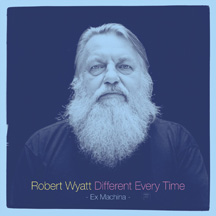
To coincide with the publication of his authorised biography, Different Every Time by Marcus O'Dair, Robert has selected and released a 2-CD career retrospective of the same name, (also available on high-grade vinyl*). CD 1 Ex Machina is a selection of classic Wyatt solo tracks; CD 2 Benign Dictatorships samples the best of his collaborations and guest appearances with other artists. If you are not really familiar with his work, or want to own a representative cross-section of his recordings, this is the perfect place to start!
Ex Machina is a punning reference to Robert's enforced existence as a wheel-chair user since he broke his back in a fall (or did he jump?) from a fourth floor window at a drunken party in June 1973. Yet 10 of the 13 songs on the album (and all 17 on CD2) date from after the accident which forced him to give up drumming! He embraced his changed circumstances as an opportunity to create songs as well as tunes, and in doing so to create a unique and instantly recognisable musical persona. Indeed, the 3 pre-accident tracks are all songs which illustrate his effective use of everyday, conversational language to convey image and emotion: Moon in June, from Soft Machine's classic album Third, and two vocal excerpts - Signed Curtain and God Song - from his two Matching Mole albums. (The name of his follow up group, when he left Soft Machine under duress, is, of course a pun - on the French for soft machine, machine molle).
The other tracks on Ex Machina are selected, one song each, from his solo albums made since he returned to recording after his convalescence in 1974; he also selects the single Yesterday Man (but not his hit I'm a Believer, to which the track was the follow-up). Given the breadth of his work and styles, ranging from pop song to folk, jazz, classical, avant garde and world music, it is difficult to select stand-out tracks. However, there are clear differences between those albums where he uses a group of fellow musicians and those which are essentially self-made in his home-studio. A Last Straw from his comeback album Rock Bottom (but here in the live version from his 1974 Drury Lane Concert) and Team Spirit (from Ruth is Stranger than Richard) have strong jazz sensibilities. The former with the piano of (the other) Dave Stewart and Robert's own "mouth-trumpet" solos; the latter with its wailing sax solo from George Khan. Contrast these with the heart-wrenching vocals in his re-working of Chic's At Last I am Free - simple percussion and piano chords with a wash of synth behind it. This is a musician who refuses to be tied down by style or genre, and whose sole driving force is to communicate in words and music.
Other stand-out tracks on this CD are his comment on the 1980's, the latin rhythm Age of Self and his self-reflective Free Will and Testament. As windows onto the character and personality of Wyatt, these two tracks illuminate two of the main facades. On the one hand, there is the acutely political Wyatt, observing the folies and injustices of Capitalism; on the other, the insecurities and depressions of a major artist who, at best regards himself as inconsequential, at worst, a failure. Behind his lyrics, we catch glimpses of a man who has attempted suicide at least once, suffered from depression, alcoholism and related writer's block, and lived for over 40 years with an injury which was supposed to limit his life-expectancy and his capacity to make music. But Robert survived and prospered through the combination of bloody-minded determination and the support and love of friends, not least his wife, manager and collaborator, Alfred (Alfie) - who is also contributed lyrics on tracks such as Cuckoo Madame and Just As You Are.
Which brings us to CD2, Benign Dictatorships, Wyatt's term for the relationship between main artist and collaborators. In most cases, the tracks on this album demonstrate the power of his voice, when added to a variety of tunes written by others. There is the lyrical Robert on, for example, Jeanette Lindstrom's The River and his own chart hit Shipbuilding (Clive Langer and Elvis Costello's response to the Falklands War). On the other hand, there is the exploratory vocalese of John Cage's Experiences No2 or their collaboration with Bjork, Submarine. Personal favourites include the socialist jazz big band the Happy End Turn Things Upside Down and the collaboration with latin jazz cadre Working Week Vinceremos (We Will Win). These tracks combine Robert's clear, plaintive vocals with gentle '80's jazz, and the latter gives him the opportunity to sing in Spanish. It is just to be hoped that, despite his avowed intention to stop recording, this is just a temporary response to his loss of creative inspiration (following his giving up booze!)
The choice of tracks on Different Every Time is a careful mix of familiar and obscure, accessible and challenging - always a joy to behold, never dull. Any fan of Robert Wyatt could quibble about the omissions - my own would be the lack of The Red Flag from his Rough Trade Days, nothing from his collaborations with Gilad Atzmon, and no Pigs…(in There), his witty demolition of factory farming. But then this is Robert's choice - and a damned fine one it is too….
….but, to get maximum enjoyment, you should also buy the book (it's a bloody good read) and, if you want to take things further, explore the excellent discography and on-line sources at the back. Personally, I recommend you then purchase the complete, re-released Matching Mole albums and the bargain-priced Robert Wyatt Box Set (Domino, 2009) which contains all his post-1973 solo albums and Eps.
Martin Price
Eliana Cargnelutti:Electric Woman
Eliana Cargnelutti, Sadie Johnson, Heather Crosse:Girls With Guitars
Laurence Jones, Christina Skjolberg, Albert Castigila:Blues Caravan
Iron Butterfly:In-A-Gadda-Da-Vida (Expanded Edition)
The Moonbeams:Watching Wildlife
Martin Callingham:Tonight, We All Swim Free
Porchlight Smoker:Water Into Sand
The Fatea Showcase Sessions are a series of downloads featuring acts that we've really enjoyed and think that more people should get the chance to hear.
Click Here to get the latest session

