
Loading
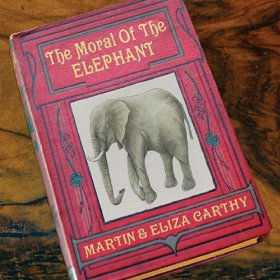 Martin & Eliza Carthy
 There's no question that this disc can be classed an exceedingly important release. Perhaps surprisingly (in view of the longevity of their respective careers to date), it marks the first proper duo album to be recorded by this father-daughter combination. Natural collaboration within the extended Waterson-Carthy family has been par for the course for many years, and I treasure the Gift album that Eliza recorded with her mother Norma back in 2010, so it's most likely simply the case that Eliza and her dad were just too busy to get down to recording an album together before now.
Whatever, certain things can be taken as given: top-class musicianship; an extraordinary sense of inter-personal sympathy and intimacy; true togetherness and counterpoint; an astute, insightful and often distinctly challenging choice of material; and absolute integrity in conception and execution throughout. All of these qualities are shot through the disc, and it may well seem unjust to review by merely clutching at highlight features when every track delivers a rendition that's incomparable in some respect.
Quite literally, the proverbial moral of the elephant is never to forget! And although each track is unforgettable in its own way, the disc's would-be-title-track is unforgettable for being almost certainly the thorniest proposition among the eleven selections, with its inherent apparent contradictions of thought cleverly mirrored in Eliza's strident and melodically twisty musical setting (somewhat reminiscent of one that Leon Rosselson might have done, I thought) conveying the essence of John Godfrey Saxe's enigmatic parable-based poem from the grist of which it is mostly derived.
Indeed, all throughout the disc the pair's instrumental contributions are unforgettable for their unerring sense of pace and dynamic, their often sparsely telling yet invariably subtle nature, with every note, nuance and fill counting at maximum significance; Martin's brilliant picking is replete with his trademark masterful spaciousness, its carefully controlled placing of the notes and chordings at the service of the song, saying so much with such economy of expression, whereas Eliza's rich and fulsome bow-work can be heart-rending (as on Waking Dreams aka Awake Awake, a song which receives a standout vocal performance too by the way) or deeply joyous (as on Blackwell Merry Night, Queen Caraboo and the stirring miners' song Bonny Moorhen where I had to do a double-take and pinch myself as I realised it wasn't Swarb guesting after all…!).
Vocally too, readings are carefully considered and thought-through, as you'd expect, while displaying an easy interpretive confidence that's born of real understanding of the chosen texts (itself born of close examination and keen, prolonged acquaintance) and a genuine respect for (and desire to pay homage to) their sources. Vocal leads are apportioned sensibly, with Martin and Eliza each taking three songs in solo mode and coming together in unison and/or harmony duet mode for creative arrangement on the remainder.
Virtuosity ain't the half of it, whether it's in the nature of exemplary synchronised breath control by both Martin and Eliza in tandem on disc finale Died For Love (this done very much in the fashion of the late Mike Waterson's famous version, and as a direct tribute to Mike) or the altogether pacier, seductive delivery by Eliza on her own (proving especially beguiling on her impassioned rendition of Michael Marra's Monkey Hair and the ultra-wistful traceries of Happiness, a beautiful song by Molly Drake (Nick's mother) which has the romantic aura of an authentic ballroom standard). And time has clearly not stood still, as we hear in the pair's now even rougher-hewn truthfulness on the present rendition of The Queen Of Hearts (first recorded by Martin on his debut LP in 1965).
There's imagination aplenty at work, too, in the pair's new interpretation of the epic Grand Conversation On Napoleon; however, although it begins promisingly with Eliza's prelude and subsequently builds the narrative well with the requisite sense of instrumental grandeur, in the end it's arguably compromised by Martin's decision to recite the epilogue; I can appreciate the rationale, but even so it doesn't fully convince me (yet). Since the latter point constitutes my only reservation, The Moral Of The Elephant can nevertheless be judged a "mammoth" success by any standards.
David Kidman
Fatea would like to congratulate Eliza Carthy on her MBE
James Delarre and Saul Rose:Cabin Fever
The Barn Door Slammers:The Barn Door Slammers
Ben Rogers:Lost Stories: Volume One
Wilson & Swarbrick:Lion Rampant
The Fatea Showcase Sessions are a series of downloads featuring acts that we've really enjoyed and think that more people should get the chance to hear.
Click Here to get the latest session

