Reviews
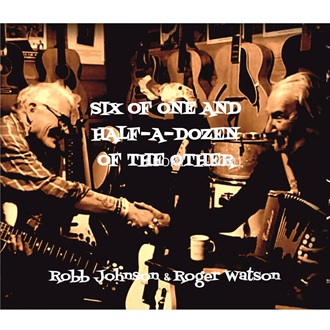 Robb Johnson & Roger Watson
Album: Six Of One And Half A Dozen Of The Other
Label: Irregular
Tracks: 12
Website: https://www.robbjohnson.co.uk/
Surely in future years when people search in dictionaries, or more likely an AI alternative, for examples of the meaning of the word 'prolific' the results will come up with a simple response - "the recorded output of Robb Johnson."
Hardly had I sent off my review of his live Souvenirs album when, like the proverbial London red bus, along came the next Irregular Records release, issue #135. A contender for the most apposite 'Album Title of the Year Award', Six Of One And Half-a-Dozen Of The Other from Robb and Roger Watson does exactly what it says on the tin, giving the listener six songs or tunes from each, alternately, odds from Robb and evens from Roger, "aided & abetted a bit here and there by RJ", apart from the final track which is credited to Roger alone.
The long-standing musical partnership between the acclaimed songwriter Robb Johnson, of whom I have opined "one of the best songwriters this country has produced…the appellation National Treasure is often over-used, but in Robb's case it is entirely appropriate", and folk-legend and maestro of the melodeon Roger Watson is a match made in utopia. Having first started to work together back in 1989, the intervening years have seen Roger playing on Robb's albums, whilst Robb has reciprocated by writing for performances created by Roger's folk development organisation, Traditional Arts Projects. Following an enforced hiatus due to a stroke in 2010, this album is his first new full recording project.
On an album which considers the relationship between folk music and real life, the enduring friendship between the two is very much to the fore, played out through musical conversations performed by voice, acoustic guitar and melodeon. Over the twelve tracks consideration is given to subjects such as the condition of England, reflections on the fleeting and transient, alongside the enduring and constant. Disparate locations such as Bengal and Blackpool feature, all within an overarching framework which explores folk music, folk process and creative cooperation.
The album kicks off with a version of Robb's 'Evergreen', a song which first appeared on the 1989 album Small Town World and which also marked the first time that the two had worked together. A gentle, quasi-bucolic representation of this fair and sceptered isle in which a visit to Bekonscot Model Village provides ample opportunity for verbal imagery and the chance to expose the myth of nostalgia for the green and pleasant land that for most was never a reality. Of Robb's other five compositions on the album, two of the songs are new. The first of these, 'The Battle Of South Street', references 1930s Worthing where a town councillor joined the British Union of Fascists, prompting Oswald Mosely to attempt to hold a rally in the pier pavilion. The good folk of Worthing were having none of this. Fierce local resistance effectively ended large-scale fascist marches in Worthing, serving as a notable precursor to the more famous Battle of Cable Street in London some two years later. As Robb sings "this is our town and we don't want fascists here", the juxtaposition of Roger's melodeon playing is nigh on perfect.
The second new offering, 'Mrs Blake' is presented as the penultimate track on the release. Another prime example of how to write a mordant critique without resorting to vitriolic, shouty performance, the song is quite simply "about how taking pride in in where you live doesn't mean painting flags on roundabouts."
With 'A Postcard From Blackpool', Robb returns to 2006, the year in which The Irregulars formed, with Roger being one of the original members, with a song which appeared on their All That Way For This album. Here, rather than the original reggae-tinged work-out, we are treated to a refined, acoustic version of a piece which Robb describes as "a truth about the human condition."
An Irregulars album is also the source for another track, 'Union Train', written in support of RMT strike action in 2022 & 2023. Once again, the original rumbustious full-band sound gives way here to an acoustic version, although some bluesy guitar and deft melodeon playing sees the pair rock-out on this one.
His final offering, 'Saturday Night In Albion', is surely up there as one of Robb's finest compositions. Originally appearing in an electric guitar, bass and drums version, again courtesy of The Irregulars, it also featured Roger providing what Robb describes as "cheekily playing "Speed the Plough" on melodeon over the choruses." Sitting firmly within the album's leitmotif of the relationship between folk music and real life, this duo version is one truly to be savoured.
Roger's set of six begins with 'The Big Ship', a tune he first heard around 1950, accompanied by a set of lyrics which celebrated the opening of the Manchester Ship Canal, "The big ship sails on the Allie-Allie-O", a tune and lyrics which bring back for me memories of rush-mats, a Coomber school radio and Singing Together. The melding of the two instruments here is superlative.
The up-tempo, sprightly tune ''Melon Juice', a dance tune which Roger originally learned as 'Gooseberry Blossoms', was imbued with African and Indian rhythms when originally played by his intercultural Boka Halat band, hence the more exotic sounding title.
'The Miners' Lifeguard' is the first of two further English traditional pieces, albeit emerging from the American Miners' Union in the late 19th century. and provides Roger with his first vocal outing on the release, as he warns "keep your hands upon your wages and your eyes upon the scale, union miners stand together…" The second is a highly impressive interpretation of 'Seafarers', which takes a song written, according to Stan Hugill, shantyman and song collector, during the last days of sail in the early 20th century by an anonymous sailor, which was then taken by another sailor who paired it with the melody and chorus of the well-known shanty 'New York Girls.' Roger admits that he sees this piece as a metaphor for his own life, and there is a definite bespoke, personal feel to the rendition.
A real treat, one of many I hasten to add, is Roger's original instrumental, 'Bengal Rounds'. Described as a short raga, which shows that it is possible to create a tune "which has a recognisable English format, which has a rhythm with an Indian relative, and which uses the scale and conventions of a particular raga." A cracking, enjoyable listen.
The album's final track is another Roger original, 'The Malthouse', written in 1973. A magnificent, majestic track with which to conclude the album, Roger's consummate artistry on the melodeon is further enhanced by Robb's guitar work, making for a triumphant finale.
Six Of One And Half A Dozen Of The Other makes for a most rewarding listen. The way that Robb Johnson and Roger Watson weave their individual musical magic around the tunes and lyrics is symbiosis personified, and they have created a memorable album.
In "EVERGREEN - SOME REFLECTIONS ON FOLK MUSIC & SONGWRITING", a companion book written by the pair, Robb poses this question "But - do we need songs about what we see around us every day…? What do you think?"
For me the answer is a resounding yes, especially when they are of such high quality as those appearing here. A second volume of collaborations please.
David Pratt
| Previous | Next |
|---|---|
| Various Artists: La Ola Nocturna : Experimental songs and deviant pop from the Spanish 80's | Luke Jackson: Soil & Seed |
Recent Reviews
- Various Artists:La Ola Nocturna : Experimental songs and deviant pop from the Spanish 80's
- Robb Johnson & Roger Watson:Six Of One And Half A Dozen Of The Other
- Luke Jackson:Soil & Seed
- Adam Sweet:Mortuary Blues
- Zoe Cure:WAVE
- Sarah Irvine:Painted Light
- Richard Trethewey:Richard Gendall's Cornish Protest Songs
- Jon Palmer:All The Day Long Day
- Jim Ghedi:Death of Robin Hood Soundtrack
- Gilbert O'Sullivan:On The Record
Captain Swing
Fatea Showcase Sessions
The Fatea Showcase Sessions are a series of downloads featuring acts that we've really enjoyed and think that more people should get the chance to hear.
Pirate is the current session and features 16 fantastic artists check out the website to find out more about them and download your copy
www.fatea-showcase-sessions.co.uk for all the artist information.