
Loading
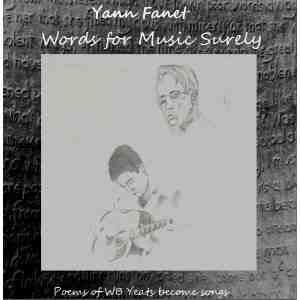 Yann Fanet
Yann Fanet is a Cornwall musician who for more than 20 years has been a true enthusiast of the poetry of W.B. Yeats; a member of the Yeats Society in Sligo, Yann's visited the region many times over that period, and immersed himself in its atmosphere and landscapes - and music - in order to experience first-hand how these aspects have variously informed both Yeats' creative personality and his published works.
Yann rightly observes that there are many features in Yeats' poetry that positively invite music - and after all, he named his 1933 collection of verse Words For Music Perhaps (hence the clever, but entirely natural, title given to Yann's own album), and himself refers to a number of his poems as songs (e.g. The Song of Wandering Aengus, The Song of the Happy Shepherd). Yann also believes that the most important of the above features is Yeats' strong sense of rhythm: by which, I suspect, he means the pulse or momentum of the verse - notwithstanding the inescapable fact that each poem will adhere more or less to a fairly strict, determined metrical structure and tempo. And of course, any songs arranged from poems will by their very nature rely just as much on rhythm as on their melody or colouring. It won't therefore always prove feasible, or indeed even desirable, to impart a less natural (or even false) sense of precedence to the rhythm element relative to the words or images themselves (although this proves a more thorny argument when the rhythm turns out to be even more essential to the total impact of the poem). Any reservations that I may have will of necessity stem from the way my own "internal voice" has interpreted the poems' rhythms over time and acquaintance, and I'd imagine that other, even more devoted followers of Yeats' work will also have their own take on that issue.
A number of the poems selected (e.g. The Happy Townland, The Stolen Child and I Am Of Ireland) come complete with their own ready-made chorus section; some others (e.g. The Ghost Of Roger Casement) have a built-in refrain, while Yann utilises a repeating-the-last-line/s-as-refrain device on occasion (Red Hanrahan's Song About Ireland); the latter small matter aside, Yann nowhere alters the texts' original wording. In terms of musical arrangement, Yann's settings are refreshing, embodying sufficient levels of instrumentation yet remaining accessible and aurally unchallenging (in the good sense); Yann's own simple guitars and bass form the bedrock, with occasional piano, mandolin, recorder or harmonica, while a further key musical element in the backdrop is provided by the charismatic violin and fiddle playing of Olivia Dunn. Other guest musicians forming the session crew include Penny Barclay (cello), Rob Parnell (double bass) and Phil Bickle and Ashley Withey (percussion).
Yann's own singing voice is melodic and light-textured, with a pleasing tone and occasional slight vibrato (a trace of non-native accent intrudes only on The Lake Isle Of Innisfree); after only a very short while you'll find yourself warming to Yann's engaging personal delivery in its own right, but I also detected occasional slight hints of Al Stewart (especially), Paul Simon and Jonathan Kelly. The styling of Yann's settings can generally be described as genial rambling-folk-troubadour I guess, though I wouldn't undersell their gentle power and overall sense of thoughtful understanding (Yann clearly knows and loves the poems). Some listeners may feel that Yann's approach very occasionally denies any incidental variety in expression that the narrative drama of the text might demand, but this can be a danger when a setting is driven by its adopted rhythm (as songs, rather than poems, tend often to be by their very nature; for instance, The Second Coming is here driven more by its thrusting folk-rock beat). And yet I rather like the refreshing, tripping gait Yann overlays on Down By The Salley Gardens (the only item on the disc for which Yann adopts the melody of another man's setting, in this case that of Herbert Hughes); and Innisfree has an attractive Log Cabin Home In The Sky feel.
For the record, I wasn't quite convinced by Yann's adoption of a waltz rhythm for When You Are Old (I hear it more like Sweet Sixteen!) - indeed, not all of the poems take comfortably to a triple-time setting - nor by the parlour-style aura of His Dream, while He Wishes For The Cloths Of Heaven feels over-extended in its use of repetition. But by and large, I believe Yann has got the true measure of Yeats' lyrical invention and manages to convey the character of the special lilt of his chosen rhythms. And if it sends folks back to the poems and furnishes further appreciation thereof, well that's even better!
David Kidman
Carthy Hardy Farrell Young:Laylam
Bob Dylan:Folk Singer - Humdinger
The Mariner's Children:Sycamore (EP)
Annabelle Chvostek Ensemble:Rise
Aly Bain et al:Aly Meets The Cajuns (DVD & CD)
The Demon Barber Roadshow:The Lock In DVD
Buzzcocks:Another Music in a Different Kitchen / Love Bites / A Different Kind of Tension
The Fatea Showcase Sessions are a series of downloads featuring acts that we've really enjoyed and think that more people should get the chance to hear.
Click Here to get the latest session

