
Loading
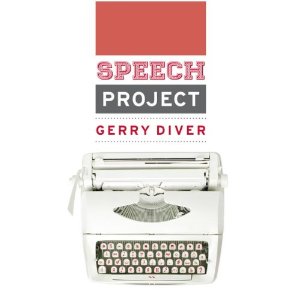 Gerry Diver
Here's another disc that's been hovering meaningfully around the player for a few months, and I could've legitimately made the excuse of holding off on reviewing it simply due to its significantly challenging nature. But it's both absolutely fascinating and, I'm convinced, genuinely groundbreaking - though you do have to be in the right, receptive frame of mind to take it all in.
Gerry's expertise as a producer has hitherto been much in evidence of course, notably in his work with Lisa Knapp, while as a musician (a brilliant fiddle player, but also more than proficient on many other instruments besides) he's probably best known for his work with Sin É and more recently with Shane McGowan and the Popes. On Speech Project, Gerry's own multi-instrumental skills are selectively augmented by a small handful of additional musicians on cellos, fiddle, uilleann pipes, flute, bodhrán and bones, the resultant scoring invariably intelligent and both delicate and empathic. But this background information gives little indication of the highly unusual, and quite spellbinding, musical delights to be found within the eleven compositions making up Gerry's daring and strikingly original Speech Project.
Basically, the Speech Project album represents the fruits of a musical journey Gerry undertook between 2007 and 2011, the catalyst for which came when listening to a recording of an interview with the late Irish accordionist Joe Cooley and incidentally realising that the trend or lilt of Joe's voice was drifting in and out of a definite musical key (B flat minor) and in a kind of slip jig rhythm. This "light-bulb moment" instigated a night-long (but exhilarating) studio session, out of which an embryonic version of the album track When In New York (one of two to feature Joe's growly voice) arose.
Inspired by this experience, Gerry arranged a series of intense yet philosophical interviews with a number of Irish musicians and singers, starting with Christy Moore and then taking in Shane McGowan, Damien Dempsey, Danny Meehan and Martin Hayes. These enabled him to pursue his own special personal quest, to explore how emotion from speech might translate into a musical composition rather than extracting it directly back out of the music via its expression in performance through the melody - in other words, instead generating a melody from it. A startlingly obvious, if also lateral, gambit, where the music takes the words out of themselves and makes from them what almost amounts to a third dimension of communication. That's no pretentious gimmick, but a genuinely fresh slant on the dichotomy of music and speech. You might recall instances in MacColl's Radio Ballads, or the works of minimalist composers such as Steve Reich (or even passages in Shostakovich string quartets), where speech patterns were emulated and translated or subsumed into the musical envelope, but here with Speech Project Gerry has bravely travelled the full long road of this musical journey and produced a magical (and, perhaps curiously, natural-sounding) result.
One might discern a kind of pattern to Gerry's invention, at least in respect of one recurring feature - and basic launching-point - whereby a specific phrase or series of words is caught as if in aspic, then copied by an instrumental line that exactly follows its individual contours of rhythm and intonation. For instance, on Old Time Musicians the fiddle seizes upon, then parrots, Joe Cooley's phrasing, turning it into a playful and celebratory jig, a mesmerising dream-time mantra. On Sincerely Felt, a lively cello line directly shadows and traces Martin Hayes's observation on being "authentically musical, inside the tradition", while on Fulham Broadway the ensemble provides train-like rhythmic motifs arising out of the metre of Christy Moore's reflections on his early days in London.
But there's more to Gerry's compositions than imitation and development of motifs in counterpoint to the spoken word; he has an acute feel for imaginative scoring that's displayed not only in the impressionistic, shimmering string arrangements but also in the quirky juxtapositions of specific timbres (one particular delight is that of piano and hammer dulcimer in consort, where it feels like the ghosts in the machine have come out to play!). On each track he builds a piquant aural collage out of the experiences and ruminations of fellow-musicians; his inspiration comes from careful observance of the intoned speech and the folk connections which are elevated through the music into a unified collective experience. In some cases this can be quite lavish in scope, as on the rather unpromisingly-titled Music For Tape Loop, where Margaret Barry's archive recording of Maids When You're Young tellingly illustrates Shane McGowan's own musings on tradition (the continuum of which is a topic examined somewhat more meditatively by Christy Moore on Million Times). Margaret Barry, incidentally, provides the source interview (for Alan Lomax in 1953) for two tracks: the poignant My Margaret and the final piece House Ceilidh (whose chiming backdrop is less reactive or organic than much of the rest of Speech Project).
But arguably the most immediately ear-grabbing of Gerry's musical collages is Famine, which both prominently features, and arises out of, the voice of master fiddler Danny Meehan (of Paddy In The Smoke fame) reciting Yeats' poem The Ballad Of Father Gilligan; Danny sure has a storyteller's gift, on which Gerry is able to build and transform into an extraordinary, pounding dramatic aria of almost cinematic proportions. The only track through which I feel blowing a slight breeze of artifice is Feel No Pain, where the soundscape is more insistently soundtrack than Damien Dempsey's deliberations would appear to generate; having said that, it makes for spectacular listening.
Summing up, then, this is a landmark disc. True, it's not easy listening: distinctly demanding in fact, in spite of its often quite accessibly impressionistic aura, and so could prove a touch too thorny for traditionally-inclined listeners, who might reasonably charge Speech Project with removing all emotion, meaning and context from the words by virtue of its innovative techniques. While one can see the logic in this observation, perhaps the biggest surprise is that Speech Project comes to bear repeated listening in a way you wouldn't expect of an artefact that to such an extent utilises repetition as a musical device. But its principal, and overriding, achievement is that it fair makes you listen in a different way.
David Kidman
Juliet Lawson:Songs From The Suitcase
Maria Jordan:What You Gonna Do?
Stiv Cantarelli And The Silent Strangers:Black Music/White Music
Jez Hellard & The Djukella Orchestra:Blood & Honey
Chris While And Julie Matthews:Infinite Sky
Various Artists:Folk Awards 2013
Julie Fowlis:Mar A Tha Mo Chridhe (As My Heart Is)
Stark:Where The Grey Slates Meet (EP)
The Fatea Showcase Sessions are a series of downloads featuring acts that we've really enjoyed and think that more people should get the chance to hear.
Click Here to get the latest session

