
Loading
 Various Artists
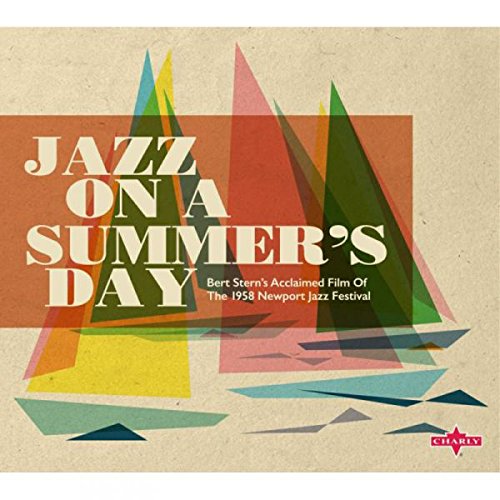
 Recently re-released as a DVD and soundtrack CD by Charly Records, Bert Stern's documentary film of the 1958 Newport Jazz Festival is a priceless record of a music and a time, a great piece of film-making, and an anachronism!
It is the first and only movie made by Stern, a talented and successful stills photographer who felt he 'had to make a movie before he was thirty'. Originally, he attempted to place the film footage of the Festival within a fictional love story, but he soon abandoned this scheme as impractical. The result is a visual treat. Stern captures the sense of place and time with the eye of an artist; almost every frame of the film is a carefully constructed composition. At the same time, his creation exhibits some of the quirkiness of a home movie and many of the qualities of an art-house piece.
Newport was always an odd setting for a jazz festival, located in one of the wealthiest summer resorts of the eastern USA, and established by some of the town's 'society' stalwarts. The audience presents a mix of New York jazz fans, young middle-class hipsters, urban blacks, and local gentry in their twin-sets and fashion hats! Intercut with local scenes, and atmospheric shots of the creeks and harbours, it is a visual feast. It is gently fly-on-the-wall, without being socio-political.
In addition to its value as a cross-sectional snapshot of 1950's America, Jazz on a Summer's Day is also an interesting musical-historical artefact. The Festival was only 5 years old when the film was shot - it has continued in various forms to this day! Yet the seeds of the decline in jazz's fortunes as the original popular music of America were already sown. The film documents this quite effectively, if unwittingly - Stern wasn't really a committed jazz fan, and his lack of awareness of trends in jazz is as well illustrated by the acts he cut from the film as by those he chose to include. Top acts such as Duke Ellington, Miles Davis/John Coltrane, Sonny Rollins, Ray Charles, Ben Webster, Lester Young and Dave Brubeck are omitted, despite the fact that several of these performances are well documented elsewhere on CD releases, (and are well worth checking out). It has been suggested that this was the result of George Avakian (of Columbia Records, and brother of Stern's co-director, Aram Avakian) calling the shots when it came to choosing which acts to include.
What Stern does do, however, is illustrate how jazz was splintering between old guard and new generation; the festival took place only 10 months before Ornette Coleman recorded "The Shape of Jazz to Come", and changed jazz forever. Louis Armstrong is shown performing no less than four tunes - probably because he was the top-paid star, netting 25% of the entire artists budget for the festival! Yet the film opens with the quirky "folk-jazz" (or what we may now call chamber jazz) of Jimmy Giuffre, with a version of his "The Train and the River". In a similar glimpse of things to come, Chico Hamilton gives an early outing to the young Eric Dolphy on flute in the atmospheric "Blue Sands". Bop appears, in the shape of Thelonious Monk ("Blue Monk"), cool jazz with Jerry Mulligan, and hard bop in the form of Sonny Stitt; a real cross section of 1950's jazz trends.
The dominance of vocalists in popular, jazz-derived music in the 50's is covered by two vocalists - and for me form some of the musical highlights of the film. Dinah Washington delivers a strongly swinging, bluesy version of "All of Me", with all of the panache of a top-flight big band crooner. Yet, as if to emphasise the shifting foundations of jazz she is accompanied by a more cool/bop jazz group, featuring Terry Gibbs on vibes and Urbie Green on trombone, Max Roach on drums and Wynton Kelly on piano.
Anita O'Day probably steals the film, however, with her two songs: a version of "Sweet Georgia Brown", which starts as a slow samba and switches into a blues, and a double-time "Tea for Two" full of vocal gymnastics in the school of Lambert, Hendricks and Ross. She matches the classiness of her singing with her look - classic '50's sleeveless black dress, trimmed at the base with white feathers, a black broad-brimmed hat, also trimmed with white feathers, white shoes and white gloves. She looked like a fashion plate - in a dress she bought from an Italian woman who ran a dress shop in Greenwich Village!
Perhaps the biggest anachronism of the film, however, is that 5 of the 17 songs are not really "jazz" at all. Rhythm and blues from Big Maybelle, rock and roll from Chuck Berry, and three gospel tunes from Mahalia Jackson, all point to the divergence of black music in 1950's America away from pure jazz, and back to the musical forms from which it sprang: blues and gospel.
The charm, and indeed the documentary importance, of Jazz on a Summer's Day stem from these inconsistencies. The result is a glorious collage of sounds and images which holds up a high-definition mirror to its times. Black and white fans are integrated in the audience at a time when segregation was stoking the fires of revolution. The divergence of popular music into a more heterodox mix is previewed, where the artist, not the record company, is setting the trends. And the human force of music is brilliantly illustrated through Stern's clever cutting from performance to audience: the socialite trying to take an 8mm film and knocking her big hat off; the young lovers smooching in the audience; the hipsters clicking their fingers and wearing sunglasses at night. And all documented in glorious colour which brings to life the gentle summer life of Rhode Island.
The film/DVD is thoroughly recommended, through the extras are mostly only of average interest - text biographies of the stars and text background to the film and festival expand on the notes in the package. The audio interview with Stern is fascinating, however, accompanied as it is by many still images from his life and work. The audio CD simply reproduces the tunes from the soundtrack - with unfortunately no bonus tracks, despite the fact that Stern and Avakian recorded many more hours of film and audio. Great value for a budget release!
Martin Price
Conor Doherty:The Savage And The Tender
Sara Forslund:Water Became Wild
Aly Cook:Horseshoe Rodeo Hotel
Hyde & Beast:Hard Times Good Times
Canned Heat:Songs From The Road
Elaine Davidson:Can't Tell The River
Eliza Carthy & Jim Moray:The Wayward Tour Live (CD/DVD)
Vera Van Heeringen:Proper Brew
The Fatea Showcase Sessions are a series of downloads featuring acts that we've really enjoyed and think that more people should get the chance to hear.
Click Here to get the latest session

