
Loading
 Dead Rat Orchestra
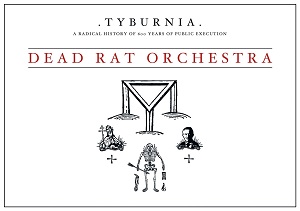
 This album presents a soundtrack to James Holcombe’s film Tyburnia: A Radical History Of 600 Years Of Public Execution; it’s the product of a full year’s research, and brings together rediscovered broadside ballads written by and for those condemned, intercut with psychogeographical field recordings, musique-concrète and lost songs in the 16th century cryptolect the Thieves’ Cant. It’s a work of extraordinary intensity, with a compelling sense of atmosphere, and its skilled assemblage is reflected by the accompanying 32-page A5 booklet in which the disc is housed, containing full lyrics and a selection of stills and images from the film itself.
Musical settings are primal and immediate, sparse yet ingenious, sometimes involving just a fiddle and some simple percussion – but these minimal resources are used to telling effect to invoke the oppressive subject-matter. For the purpose of this project, Dead Rat Orchestra consists of established “free-folk” performers Nathaniel Mann and Daniel Merrill (with some input from Robin Alderton and Lisa Knapp, the latter performing a notably chilling a cappella account of A Defence Of Women, a riposte by one Ester Sowernam to an earlier polemic The Arraignment Of Women). Their enthusiasm and authenticity prove tangible, especially so on J. Shirley’s thrumming attack on twenty craftsmen The Black Procession, which provides Tyburnia with an animated set-piece, but also on the ensuing brace of valedictory leave-takings (Tony’s Lamentation and Jonathan Wild’s Last Farewell To The World), Edward Ward’s South Sea Ballad, the admonitory A Budg And Snudg Song and Thomas Dekker‘s cryptic exhortation Bing Out, Bien Morts.
The archaic yet timeless feel of the texts is powerfully brought home to the listener, who is invited, by dint both of the starkness of the delivery and the interpolation of almost painfully apposite extracts from the likes of street criers and orators, screaming crowds, even a mournful silver-band hymnal, to reflect on their relevance not only to the historical timeframe in which they were first conceived but also to present-day ideologies (plus ça change, in effect…). In doing so, providing a powerful political statement and implied indictment on our own times. Tyburnia is at times distinctly uncomfortable listening, make no mistake – but it proves worth rising to the challenge.
David Kidman
Gordie MacKeeman & His Rhythm Boys:Laugh, Dance & Sing
Ron Sayer Jr & Charlotte Joyce:Live At The Little Theatre
My Quiet Companion:My Quiet Companion
Rebecca Van Cleave:The Bedroom Sessions EP
The Black Feathers:Down By The River
Kate O'Callaghan:Feel/Young Hearts Run Free
Steve Martin & Edie Brickell:So Familiar
The Fatea Showcase Sessions are a series of downloads featuring acts that we've really enjoyed and think that more people should get the chance to hear.
Click Here to get the latest session

