
Loading
 Bonnie Dobson
 High-profile "child of the 60s folk boom", having barely attained the age of 20 sharing the illustrious company of Judy Collins, Carolyn Hester and Joan Baez in a 1961 Time magazine article, Toronto-born Bonnie came back into the spotlight in the spring of 2014 by releasing a brilliant "comeback" album which reinforced her claim to fame as one of the foremost female song-interpreters of her age (this quite aside from her penning the iconic Morning Dew!). Even then, Bonnie was a force to be reckoned with, a singer with a hell of a personality.
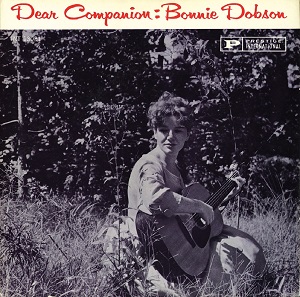
Her talent was there for all to hear on the four albums she made for the Prestige label in the heady days of the early 60s, of which the first (1960's She's Like A Swallow…) was reissued by Ace Records a few months ago (and reviewed here). Dear Companion was its direct sequel, released swiftly on the heels of its predecessor that same year, and contains more of the same - i.e. peerless, purely-driven, heartfelt and uncompromisingly sincere renditions of carefully-chosen material that invoked and exemplified Bonnie's own personal manifesto "("I sing any song which has substance and content, meaningful and genuine emotion, and is couched in language which is simple and direct").
All of which here typically entails a classic Child ballad (The Cruel Mother) and other traditional fare (When I Was In My Prime, Girl Of Constant Sorrow), sitting perfectly companionably and naturally alongside a swooningly sensuous account of a Brownie McGhee number (Blues Jumped A Rabbit), and even a handful of songs sung in their native language (songs from Serbia and Czechoslovakia, and two cheeky French-Canadian folksongs). Two of the disc's standout tracks are those delivered a cappella: the poignant Dink's Song (which Bonnie first heard from the singing of Pete Seeger) and the self-penned (though astonishingly authentic-sounding) Ben's Lullaby. Accompaniments are kept admirably simple - only Bonnie's guitar for much of the time, with very occasional embellishment from flute (Isabel Gardner) or second guitar (Peter Gardner) and, on just a couple of tracks - The Bonnie Lass Of Kenmore Town and Vertsa Dievcha - vocal harmonies (Hennie Kubik).
This well-considered mix and Bonnie's outstandingly mature performances make for spellbinding listening, that's for sure. Ace Records' magnificent state-of-the-art reissue boasts a fine new booklet essay and also reproduces the original sleeve notes by Pete Welding and Bonnie herself. Timeless and essential.
David Kidman
Various Artists:Downtown:Folkstock Records
Jason Tyler Burton:The Ballad Of Sally Moore EP
Tobias ben Jacob & Lukas Drinkwater:The Burning Low EP
Freeland Barbour:The Music And The Land
Tom Russell:Love & Fear/Song Of The West
Casee Wilson:Here At A Distance
The Fatea Showcase Sessions are a series of downloads featuring acts that we've really enjoyed and think that more people should get the chance to hear.
Click Here to get the latest session

