
Loading
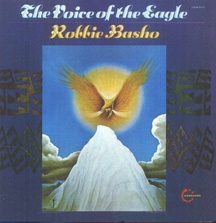 Robbie Basho
 Robbie Basho, who died in 1986 aged just 45, was born Daniel L. Robinson, but transformed into Robbie Basho after an overnight peyote-fuelled mountain sojourn, declaring himself a reincarnation of 17th century Japanese haiku poet Matsuo Basho. He's little more than a name to most music fans, barely a footprint on even the radar outside of a reputation for eccentricity and wilful obscurity; however, he has a definite place in the pantheon of underrated cult guitarists, that's for sure. Starting in the mid-60s, he recorded a series of six retrospectively influential albums for John Fahey's Takoma label, and yet he should be regarded as more of a trailblazer than a mere follower of Fahey, for his playing style and modus operandi owed far less to Fahey's primitive country-blues-derived music than to the esoteric world-music-derived improvisations favoured and pioneered (in parallel) by Davy Graham in particular. While at the University of Maryland in the late 50s-early 60s, Basho first encountered Fahey and then, armed with an old Mexican 12-string guitar, swiftly delved into country blues, bluegrass, oriental and free improvisatory classical music and eagerly pursued the exploration of exotic tunings. His label debut, 1965's The Seal Of The Blue Lotus, mingled raga excursions with spiritual reflections, while later LP releases saw him keenly embracing Native American mysticism and developing a powerful singing voice.
Following his stint with Takoma, Basho recorded a pair of albums for the Vanguard label, the first of which was 1972's The Voice Of The Eagle. This record is an ecstatic outpouring of music and song that uses the simplest of palettes to conjure up a potent spiritual experience, much inspired by or developed from Native American sources (this was a peak for Basho in terms of his immersion in that culture). Intensely varied in expression, often obeying no known or acknowledged musical laws, flying free of all constraints (like the eagle, the solar messenger of the gods), this is strangely compelling music that refuses to date or to tie itself to any conventions. The seven-minute title track is best described as a Hopi raga; Wounded Knee Soliloguy is a poetical feeling of lament for the atrocity of the 1890 battle. Blue Corn Serenade is perhaps the thorniest track structurally, contrasting with Sweet Medicine which brings to the fore Basho's skill in virtuoso whistling to a close-miked mellifluous 12-string backing. Roses And Gold turns out to be an unexpectedly tender love-song, and finally Moving Up A Ways returns us to the world of Navajo "drama-myth". It's great to have this music available again courtesy of the good folks at Ace Records, whose continuing commitment to Basho's far-out muse will, I fervently hope, see his entire output reissued before too long (we already have the aforementioned Seal Of The Blue Lotus, together with Zarthus and the Bashovia and Guitar Soli compilations). With splendid, authoritative liner notes by Kris Needs, and in excellent remastered sound, this disc represents a peerless introduction to this stage of Basho's art.
David Kidman
Southbound Attic Band:Our Day In The Sun
Struileag:Children Of The Smoke
Ralph McTell:The Unknown Soldier EP
Micah P. Hinson:Micah P Hinson And The Gospel Of Progress
Kadia:The Beast Of Bodmin Moor
Chris Smither:Still On The Levee
Wookalily:All The Waiting While
The Fatea Showcase Sessions are a series of downloads featuring acts that we've really enjoyed and think that more people should get the chance to hear.
Click Here to get the latest session

