
Loading
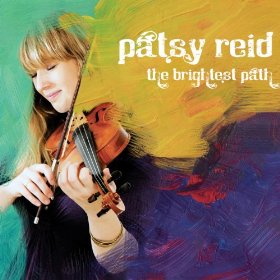 Patsy Reid
 In the two years since Patsy Reid left the highly acclaimed Breabach, she has been a very busy fiddler: an album and tours in 2012 and 2013 with her three piece, Vamm; performing as part of The Cecil Sharp Project, Zakir Hussain's Pulse of The World, and Kathryn Tickell's Northumbrian Voices; a UK wide tour with Kathryn Roberts and Sean Lakeman; numerous Celtic Connections commissions, contributions on fiddle, cello and viola to a myriad of albums including Bella Hardy, Donald Shaw, Treacherous Orchestra and Tim Edey; teaching fiddle at various courses and institutions; and an exotic residency in India as part of Folk Nations.
Patsy's third solo album and the first since 2008, 'The Brightest Path' was released earlier this week and is being showcased in a UK tour with dates up to the end of May. Co-produced with drummer and engineer Mattie Foulds, recorded on the beautiful west coast of Scotland at Crear and with funding from Creative Scotland its 10 tracks are not your usual Scottish fiddling fare, but are an inclusive reflection of her musical journey since leaving Breabach. Even though classed as a solo album 'The Brightest Path' has heavyweight contributions by well-seasoned musicians in the shape of Ewan MacPherson (guitars, banjo and mandolin), Ben Nicholls (double bass and harmonium), Mhairi Hall (piano), Signy Jakobsdóttir (percussion), Mattie Foulds (drums and vocals), Fraser Fifield (soprano sax and whistle) and Patsy herself on fiddle, viola, cello and vocals, and is a vibrant mixture of various traditional, contemporary and self-penned songs and tunes.
The album opens with Patsy's jazz influenced seamless 'Hooray Henry', which begins with a drums and bass groove with interplay from banjo and piano, overlaid with fiddle playing centre stage, building up into a three pronged attack of fiddle, viola and cello, followed by sax dovetailing the main theme. This unusual arrangement of instruments in this setting complements each other and 'Hooray Henry' wouldn't be out of place on Manfred Eicher's ethereal ECM label.
Patsy's two other tunes 'Thugainn' and the album closer, the charming 'The Baby Tune', clearly demonstrate the strength of all the musicians having a hand in the arrangements, and the latter contains some lovely mandolin playing especially in the lullaby finale.
'Donside' a set of two Strathspey's from the Athole Collection archives in Perth is the first visit to 18th century traditional tunes. The slower longing of 'Don Side' with its fiddle and piano accompaniment interwoven with some subtle snatches of low whistle, counter melody second fiddle and glockenspiel gives way to the more upbeat second tune 'Mrs. Ross's Rant' with fiddle and low whistle sharing the lead.
The other visit is a set of 3 tunes, 'Bridge of Garry', begins with a jazzy folk arrangement of 'Miss General Campbell' followed by the more traditional setting of the reel 'Bridge of Garry' and ends with the strathspey 'Fouller's Rant'. This set highlights the virtuoso skills of Patsy's playing especially in the different styles of bowing she brings to the tunes.
Apart from the self-penned tunes there are two contemporary ones from writers Patsy has worked with. Having not heard Capercaillie's Donald Shaw's original slow air 'A Precious Place' from his Hebrides - Islands On The Edge suite which Patsy played fiddle on, I don't know if her arrangement remains true to the original. What I know is that this version is one of my favourite tracks on the album and reflects the time spent on the Folk Nations residency in India. It's a relaxing almost transcendental mix of Scotland meeting India complete with morning raga inspired guitar lines with harmonium laying drone like undertones, pitched percussion embellishment held together with some melancholic fiddle playing. 'Lost In Green' a tune written by melodeon player Julian Sutton who with Patsy were part of Kathryn Tickell's Northumbrian Voices, has a modern feel to it mainly due to having the soprano sax as a main instrument and conjures up images of a gentle North East folk dance.
Between the instrumentals there are three contemporary songs sung by Patsy. I am sure that this is the first recording of Ewan MacPherson's 'The River Princes' which contains the album's title in its lyric and has a rock ballad feel to it which could be destined for the Radio 2 playlist. The interpretation of both Hem's Dan Messé's 'Half Acre' and Patty Griffin's 'Kite' can be described as chamber folk. On both tracks the piano dominates and is enhanced by the pastoral feel of Patsy's violin, viola and cello with added guitar and glockenspiel on 'Kite'. All three songs suit Patsy's pure tones which are too pure for me as I prefer edginess to female vocals. Having said that, the interpretations of all three songs are more than mere copies with especially 'Kite' being completely renewed from the simple plaintive piano musings of the original.
'The Brightest Path' has made interesting listening and in the main an album I really like. No doubt the tranquil beauty of the location completed by the different moods of the weather and the colours of the landscape have been captured in the songs, tunes and recording and also with the collective feel to its creation. The album refuses to be pigeon holed which to me is its greatest strength.
Chris Light
The Wild Man Of Europe:Old-Fashioned Flames
SheedyFrost And Guests:Songs From The Park
Steve Scott Country:Those Tears I've Cried
Ashley Riley:All The Pretty Things
The Redlands Palomino Company:Broken Carelessly
The Fatea Showcase Sessions are a series of downloads featuring acts that we've really enjoyed and think that more people should get the chance to hear.
Click Here to get the latest session

