
Loading
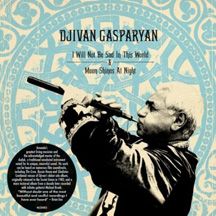 Djivan Gasparyan
 The national instrument of Armenia is the double-reed duduk, and no duduk performer has had quite the same cultural impact as 85 year-old Djivan Gasparyan. You're quite likely to have heard him play; the duduk, and therefore Gasparyan, has been utilised many times by film composers trying to convey an ominous and distinctly foreign mood, most notably in Gladiator. He is considered Armenia's greatest living musician, proclaimed the Master of the Duduk, and has toured the world for over 50 years.
This combined reissue of his two earliest albums, 'I Will Not Be Sad In This World' and 'Moon Shines At Night', alongside a farewell tour over the next 12 months, is something of a lap of honour. And such honour. Despite the fact that much of the music on these albums is over 30 years old and lacks any sort of pulse, it is compelling to say the least.
'I Will Not Be Sad In This World', written initially in 1983, was a title chosen by Brian Eno, who after hearing it for the first time deemed it as 'Without doubt one of the most beautiful and soulful recordings I have ever heard.' It's hard to disagree with him. With most tracks accompanied by a second duduk playing a simple drone, it would be easy to predict becoming restless listening to a full album of duduk music. However, opening track 'A Cool Wind Is Blowing' provides a perfect musical portrayal of the title, conjuring up images of deserted landscapes and peaceful surroundings, with just a hint of unease.
Once you have listened to one track, it is difficult to pull yourself away, as the hypnotism of the music and the peerless emotion of Gasparyan's playing lures you in. The duduk itself contains a huge range of tone, being able to sound harsh and then tranquil almost instantly. In contrast to the opener, the title track has more of a positive feel to it, and could almost be considered a lullaby. In fact, every title seems perfectly apt for each piece; in particular the gentile and intricate approach to 'Little Flower Garden' is perfectly judged, and this is one of the main reasons that the album is more diverse than you'd think at first.
The second album, 'Moon Shines at Night', released initially in 1993, begins in much a similar way, with 'Lovely Spring' giving off a similar mood to 'Little Flower Garden'. Further into the album, however, a larger amount of variety begins to reveal itself. There is a dense quality to 'Tonight', explained quite simply by the addition of a third duduk. Here, the harmonies are rich, and play slow, elegant melodies befitting that of a sunset.
Due to the nature of the music, each track appears to blend into another, and you'd be hard pushed to recognise which is which after one listen. Across both albums, Gasparyan only changes the formula twice, singing on the track '7th December 1988', a date that recalls the Spitak earthquake that killed 25-50,000 people in northern Armenia. He also sings on the final track, the hauntingly sparse 'Mother of Mine'. Here, his voice appears hushed, and all accompaniment is muted. It's an understated end to the album, but brings a welcome change of mood and dynamic.
Players like Djivan Gasparyan are considered a gift to the listener and a hero to their countrymen. Gasparyan will not be touring after this year, and if you aren't one of the lucky ones to see him, then these albums are a fine memento of his illustrious career, and his beautiful playing.
Laurence Morgan
The Hillbenders:Can You Hear Me?
John Coletta:...Sleekit, Slithers...
FagervallBjorkenvall:The Silence
Rainbow Reservoir:400 Imperfect Rhymes
Martyna Wren:The World Can Wait
Rainbow Chasers:Chimes At Midnight
Simon Nicol:Before Your Time… & Consonant Please Carol
Otis Gibbs:Souvenirs Of A Mis-spent Youth
The Fatea Showcase Sessions are a series of downloads featuring acts that we've really enjoyed and think that more people should get the chance to hear.
Click Here to get the latest session

