
Loading
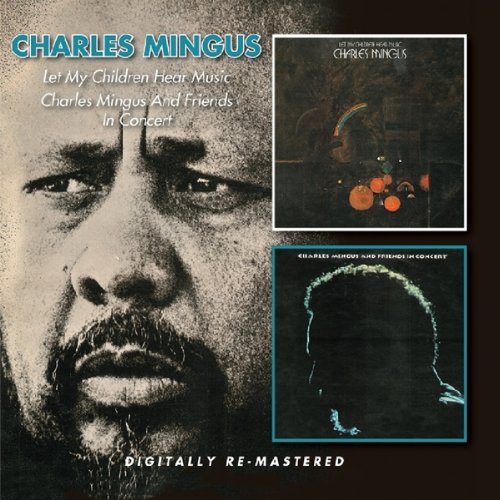 Charles Mingus
 This welcome addition to BGO's continuingly excellent re-issue series documents Mingus' emergence from a period of relative inactivity and clinical depression in the late 1960's. Although there are some CD's of live concerts available from 1965/66 and 1970, Let My Children Hear Music (released 1972) represents Charles' first attempts at studio recording since 1966. Charles Mingus and Friends in Concert is a record of his concert at the Philharmonic Hall, in New York's Lincoln Centre, in February 1972, to launch his comeback album, which was itself then released as an album in 1973.
At this stage in his career (Mingus was to die in January 1979) the great jazz instrumentalist and composer was very much looking back, and attempting to summarise his career and his musical legacy. Indeed, at the same time as the two albums came out, he also finally released a version of his autobiography, Beneath the Underdog. Much of the renaissance of his career, as he hit 50, was due to the support of his final partner, Sue Graham/Mingus. She had largely nursed Charles back to performing, and acted as his manager for the latter part of his life. Hence, the material on the studio CD includes reworkings of several previously-recorded pieces, and quite a few tracks which have been spliced and edited from different takes to achieve maximum impact. The result is often more orchestral and through-written than earlier Mingus works, with less space for solos, but more attention to layering of sound to give textures and colours to his compositions. That's not to say that these are cold, emotionless tracks, or that they lack stellar soloists: the Concert album gives plenty of solo space to the most famous "Friends". It's just that Mingus appears to be focussed upon exploring as many sonic facets of his own writing as possible within one piece of music.
Let My Children Hear Music contains seven tracks - three new works, three reworkings of previously-recorded pieces, and one other, The Chill of Death written by Mingus in his late teens! The tracks are by a big band, but there is still considerable confusion over the complete personnel. The opening track, The Shoes of the Fisherman's Wife Are Some Jive Ass Slippers, is a reworking of a 1965 track (Once Upon a Time There Was a Holding Company Called Old America). It is complex, shifting modes and time constantly - from dirge like slow sections to up-tempo swing, and even free sections of counter-improvisation by three or four brass and reed instruments. Don't Be Afraid, the Clown's Afraid Too is a similarly complex revival (" a ten-melody fugue"), orchestrated by Si Johnson and full of playful time changes and circus-march themes. Between these two tracks, Mingus' Adagio Ma Non Troppo is the Jaki Byard arrangement of Myself When I am Real - a particularly beautiful, slow, sonorous Spanish-style piece which could have fallen off a Miles Davis (Sketches of Spain) session. Taurus in the Arena of Life is clearly meant to be autobiographical - Mingus star sign was Taurus, with Taurus rising! It again features short sections in different modes and tempos, from an initial Mozart-played-by-pub-piano to slow ballad, snatches of Spanish themes and free improv., to trumpet solo (Snooky Young?) over traditional big band section-playing. It appears to be saying - 'this is all my life in music'. For some reason it did not appear on the original vinyl release. Hobo Ho is slow, bluesy and low-down dirty, and features Bobby James tenor soloing. Mortality is again explored on The Chill of Death, with Mingus narrating his own poem over a backcloth of themes which could be snatches of film soundtrack. Finally, The I of Hurricane Sue is a tribute to his life-partner (and perhaps a comment on their relationship). Yet again, Mingus "cut-up" style mixes swinging themes, dissonant bursts of sound and counter-melodies with a great tenor solo (James Moody?).
The live Concert album covers most of two Cd's, and includes fresh versions of Taurus, The I of Hurricane Sue, and Don't Be Afraid, together with eleven other tracks - mostly from Charles' extensive back catalogue. The 24-piece Band includes star soloists of the calibre of Lee Konitz (alto), Gerry Mulligan (baritone), James Moody (flute), Gene Ammons (tenor), Milt Hinton (bass) and Randy Weston (piano), and even features Dizzy Gillespie (vocals!!). It also introduced 18-year old John Faddis on trumpet, depping at the last minute for a sick Roy Eldridge.
After an introduction by Bill Cosby, the band launches into Jump Monk, Mingus' 1955 tribute to the great pianist - an opportunity for several of the soloists to shine, including Ammons, Charles McPherson (alto) and Lonnie Hillyer (trumpet). This gets the concert off to a cracking start, before the band launch into ESP, a reworking of an even earlier (1952) piece, with solos by Ammons, Konitz, Mulligan and Hillyer. Ecclusiastics (1961) is a typically slow, meandering Mingus blues/gospel piece - again giving plenty of solo space - before shifting up in tempo to a raucous finish reminiscent of Don Ellis's Electric Bath style. Eclipse was written by Charles in 1953 for Billie Holiday; here this slow, soulful ballad is sung by Honey Gordon. There are long saxophone solos for McPherson, Ammons and Bobby Jones on the unexceptional new swing number Us Is Two. Taurus in the Arena of Life is the first piece to be reprised from the 1971 sessions (CD1), featuring Eddie Preston's trumpet, and this is followed by the slow Mingus Blues, with its opening bass solo from Mingus eliciting a strong audience reaction, as it leads into Ammons sax solo. Finally, CD 2 finishes with a new Mingus composition, Little Royal Suite, spotlighting the young John Faddis, in a trumpet feature written for the laryngitis-stricken Roy Eldridge. The slow initial section is strongly Ellingtonian in style - as one would expect from Mingus, a huge fan of the great jazz orchestral composer. The piece then shifts in tempo, before dropping back into a slow 'film noir' section, then lifts again into a swinging theme with plenty of solos from the sax stars and from drummer Joe Chambers. At over 20 minutes, this is arguably the most significant track in the concert.
CD3 commences with Honey Gordon singing Strollin', a blues which she originally recorded with Mingus in 1959: the vocals give way to a slew of solos. The I of Hurrican Sue from the studio album is then introduced, followed by the great Mingus driving blues E's Flat, Ah's Flat Too from his famous Blues and Roots album (1960). Mulligan gets a chance to shine in the Pepper Adams role on baritone sax, while Faddis, Konitz, Weston and Moody all have solos which are enthusiastically greeted by the audience. Dizzy Gillespie vocalises on his co-composition Ool-Ya-Koo - rather like Armstrong, his vocal scatting demonstrates his solo structures as ably as his trumpet playing! Another perennial of Mingus' - Portrait (originally God's Portrait in 1949) - gives Honey Gordon another outing, as well as featuring Moody's flute. Finally, the concert ends with Don't Be Afraid, The Clown's Afraid Too - as Mingus' talking-bass solo leads straight on from Portrait. Again, the lion's share of solo space goes to Faddis, followed by the sax stars - over a theme typical of Mingus style - close blends of saxophone, trombone and French horn, with flute and trumpet flourishes over, and a jaunty rhythm section underneath.
In summary, this box set of 3 CD's is an essential record of this phase of Mingus career. Treat yourself to a feast - buy it today!
Martin Price
Billy Bragg:Live At The Union Chapel CD/DVD
Micah P Hinson And The Nothing:Micah P Hinson And The Nothing
Birds Of Chicago:Live From Space
Eric Brace and Karl Straub:Hangtown Dancehall
Rackhouse Pilfer:Love and Havoc
Rosalie Genay & Rebecca Nash:Realms
Courtney Barnett:The Double EP: A Sea of Split Peas
The Fatea Showcase Sessions are a series of downloads featuring acts that we've really enjoyed and think that more people should get the chance to hear.
Click Here to get the latest session

