
Loading
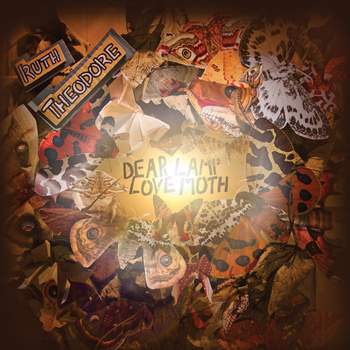 Ruth Theodore
If you think some of the new crop of folk/alt/indie singer-songwriters be strange, then prepare yourself for another assault on your preconceptions with this latest record from the humbly (yet uncompromisingly) strange and perennially challenging East-London-based Ruth Theodore. It's her third album release, and, although self-evidently heralding a difficult but intensely rewarding artistic development from the critically well-regarded White Holes Of Mole Hills (2010), it also stands very much alone as a pinnacle, both of achievement for Ruth (after its very recording was interrupted by a sudden bout of serious illness), and of weirdness (even by Ruth's own standards). But then of course, weird is good (I say)! …
Here, weird means fractured structures, songs always heading in unpredictable directions, deliberately violent and disruptive imagery couched in seemingly wilful vocal acrobatics and unconventional guitar tunings. And that's not the half of it. But yet, Ruth's fantastic inventiveness is compelling in the extreme, and intimately communicative - you can't help but be drawn into her world. Her extraordinary vocal characteristics alone ensure her work's uniqueness - by turns fragile and delicate, woozy with drunken passion, kittenish and playful, angrily dramatic. And then there's her highly skilled yet determinedly quirky lyric invention - replete with seriously unforgettable imagery that indelibly imprints itself on your psyche, and all couched here in startling, attention-grabbing (yet economic) instrumentation. The ambitious ten-minute opening song, Strings, is scored for an unorthodox chamber-folk ensemble comprising French horn, cor anglais, oboe, cello, viola, bass and drumkit, with Ruth's chameleon guitar slipping in and out of the oddly episodic proceedings (after many many plays its alternation of niente, stop-and-start, sudden-death and life-abundance moments can still wrongfoot you, and the questing metaphysics remain resolutely imponderable). After the arrestingly complex Strings, the remaining nine songs ought to feel like plain sailing, but they don't! Even the skewed cheeky-chummy colloquial of Archimedes, the casual-sounding entreaties of Algae and the more sophisticated, would-be-even-toned pop sensibility of The Heart don't quite follow the advertised path through their comparative brevity.
Every one of the songs has its own particular flavour, and inhabits a climate of exploration with undisputed originality. The darkly cryptic flittery quasi-operatic scena of Psychosis And The Willow provides a catharsis of sorts, where the contrasting neo-classical and Kurt Weill jazz-cabaret resonances are strikingly disturbed and tweaked by vocal squeals and trills; Slowdance has an element of ISB/Dr Strangely Strange in its abundantly playful view of conventional romance. The arresting part-sprechstimme delivery of Snakes And Ladders passes hypnotically with the motion and sound of a watch swinging across ticktock in front of and behind your very eyes, while its mantra "fear can be a terrible illness" serves not just as a central metaphor for life but as a logical consequence of the violence threatened in the previous song Bullfight.
For all her musical dependence on irregularity and the unexpected, and her use of almost cinematic cross-cutting techniques, logic proves a powerful element in Ruth's songwriting, even though it may not always be apparent, especially at first: one might almost give up trying to make sense of her cryptic or oblique observations, but then things start to fall into place and you just prefer to be with Ruth, off-kilter with the rest of the world though that may be…Her vision of the world, time and existence may be scary, certainly spine-chilling, but it's also enormously stimulating, and her creativity in setting this into a musical context seems to know no bounds; in this endeavour she commands loyal support from her long-term collaborator, co-producer and bassist James Hurst and a team of expert players comprising Hannes Arnold, Hannah Oliver, Krisztina Gyura, Melissa Dobson and Joe Allen (the latter providing the eccentric percussion touches - eat yer heart out Pete Flood!).
The amount of work that's gone into this album is astounding, and your own degree of effort in getting to know Ruth's music will, I guess, be considerable too, but hell it will be worth it, and how. It's fun to investigate too. And in the end, it really is impossible to ignore Ruth's talent.
David Kidman
Kiki Dee & Carmelo Luggeri:A Place Where I Can Go
Israel Nash Gripka:Israel Nash's Rain Plans
Enter The Haggis:The Modest Revolution
Benjamin William Pike:Being And Nothingness
The Fatea Showcase Sessions are a series of downloads featuring acts that we've really enjoyed and think that more people should get the chance to hear.
Click Here to get the latest session

