Reviews
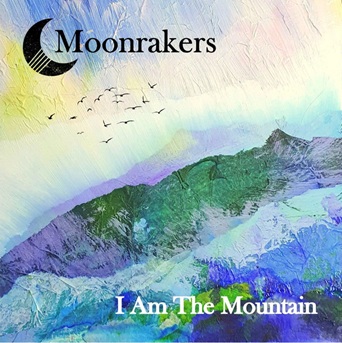 Moonrakers
Album: I Am The Mountain
Label: Self Released
Tracks: 12
Website: https://www.moonrakers.net/
An Oxford quartet named for the insulting colloquialism of folk from Wiltshire and composed of Jon Bennett on vocals, bouzouki, guitar, whistles and bodhran, crystal pure-voiced vocalist Sarah Fell, cellist Jacqui Johnson and Becki Luff on harp, this is their eighth album, again a combination of their arrangements of traditional songs and Bennett's originals.
Led by mournful cello, they kick off with 'Sickle Moon', the slow and atmospheric six minute plus opener to their Winter show, a song about the transitioning from the darkness of the season back into spring ("the King of Dark, a watching crow/Will be the keeper of our soul/And then upspoke the sickle moon/Turn to Spring again") set against a medieval druidic backdrop ("We hide our runes beneath a cloak/And brave the haunted woodland way").
With its "Hark, hark, the dogs do bark/And the beggars come to town/ Some in rags and some in jags/And one in a velvet gown" refrain appropriated from a centuries old plague song, Hark, Hark! nods to a more recent pandemic, the velvet gown evoking a certain House of Lords member under investigation for making a fortune by providing allegedly useless equipment to the NHS ("This gown is our entitlement through which we give out favours/Our loyal friends, make no amends when they steal your tax and labour/And when the honours list is read and names are carved in stone/We'll soon forget the common folk buried bone on bone").
Another lengthy number, over five minutes, opening with cello drone and a rumbling patter of percussion before the circling fingerpicked guitar sets in, the Arabic-coloured 'East Bound' is an instrumental co-write between Bennett and Johnson, written as a lament for the tragedy unfolding in Sudan, the track gradually building in intensity midway before the urgency dissipates into the ether.
Having been in existence since 1998, they finally get round to a song explaining their choice of name, the lively steady stomp along 'Rake The Moon', sung by Bennett with shimmering harp and crowd-friendly chorus, being rooted in Wiltshire smuggling history where barrels would be hidden in a pond and, if caught, they'd feign idiocy and claim to be trying to rake the moon's reflection ("the Sherrif's men came riding by, in search of contraband/But fooled they were by cunning minds of those who work the land"), the moral being "when you see a grinning man with little to his name/Don't call him out to be a fool, he plays another game".
A second instrumental, arranged by Luff and Johnson, the traditional 'Jenny Nettle's Reel' is taken from the 1972 third edition of Niel Gow's 'Reels', a tune with Irish origins but also Scottish and Northumberland variants, the cello and harp arrangement adopting a more mid-tempo and shape-shifting pace than usual.
A nimbly fingerpicked number, 'Ronson Avenue' draws on Bennett's family history ("in the corner of the garden there's a hiding place for stories/An old tin bath and a hundred little voices"), the title referring to where his grandmother, a nurse, lived in Stoke-on-Trent taking in children evacuated during the Blitz ("When the doodlebugs were raining down/And the outside world was a roaring sound/We held it all inside, to face the coming tide") and checking them out medically before being sent north to foster homes.
The first of the traditional songs is the familiar much covered sororicide ballad 'Two Sisters', (a harp substituting for the usual fiddle) here, sung by Fell, given a slow, melancholic arrangement with pizzicato flourishes with the final stretch rendered unaccompanied before spectral piano, cello and harp notes bring it to a close.
Written by Bennett, the steady walking-paced five and a half-minute title track, Bennett and Fell's harmony vocals weaving an anthemic spell links to the Right to Roam campaign with ramblers and environmentalists seeking to gain public access to what was once common land, asking "Can you buy the air or the line of the land/Trade with the wind or the sleeping sand?/Can you hold down the waters of a mountain spring/Buy shares in the shadow of an eagle's wing?/Can you count the ears of the winter corn/Dry the tears of a summer storm?/Can you still walk tall in the burning ash/Of prairies bought with blood and cash?".
The third and final instrumental, 'O'Carolan's Draught/Home Ruler' combines a tune by the blind Irish harper from the 1700s with a hornpipe from the mid-1800s by Ballycastle's Frank McCollum, the stately harp and whistle melding into the frisky guitar and cello driven second tune.
A political note is introduced with the strummed and sonorously sung 'Black Beach', a traditional-styled number inspired by Bennett taking photos of ex-miners collecting sea coal washed up on the beach at Merton on the County Durham coast., selling this third-grade slurry for about £5 a sack ("a pittance and a penance for the men who dug the coal"), with one approaching saying "Don't show me face, they'll take away me dole". Coming on the heels of the 40th anniversary of the Miner's Strike, it sounds a powerful note about the fallout from an industry's betrayal ("Friday we were told, and Monday we closed/The last turn of the wheel and siren's call/And all that's left are monuments to solidarity/And twenty years of backs against the wall/It wasn't long ago we were half a mile below/The rasp of me breath will tell you more/The black diamonds left us
living hand to mouth/Now we gather up the dust upon the shore").It ends with two traditional numbers, first being Bennett and Fell sharking vocals on 'Fathom the Bowl', a chorus-friendly wassail-like swayalong 19th century English drinking song sometimes known as 'The Punch Ladle', the voices intertwining towards the end where, with harp, cello and whistle, they introduce their own last verse rewrite to suit the instruments ("So raise up your arm and put a bow to the strings/We'll strum the chords loudly and let the harp sing"). Aptly then, it ends with another toast in the form of a cello-anchored melancholic reading of the Scottish traditional 'Parting Glass', first appearing in a 1654 broadside and sometimes adopted as a funeral farewell with its poignant line "since it falls unto my lot/That I should rise and you should not". As befits the title, the album finds them at their musical peak.
Mike Davies
| Previous | Next |
|---|---|
| The Gleeman: You'll Land Among The Stars | Ma Polaine's Great Decline: Monster Swan |
Recent Reviews
- Zoe Cure:WAVE
- Sarah Irvine:Painted Light
- Richard Trethewey:Richard Gendall's Cornish Protest Songs
- Jon Palmer:All The Day Long Day
- Jim Ghedi:Death of Robin Hood Soundtrack
- Gilbert O'Sullivan:On The Record
- Anna Anise:Aneth
- Strawbs:Grave New World Live - Strawbs 50 Years On
- Pavel Shalman and Boki Radenkovic:Klezmer & Wir
- Mary Dillon, Neil Martin & Dónal O'Connor:North Of Here
Grimsby Fisher Lads
Fatea Showcase Sessions
The Fatea Showcase Sessions are a series of downloads featuring acts that we've really enjoyed and think that more people should get the chance to hear.
Pirate is the current session and features 16 fantastic artists check out the website to find out more about them and download your copy
www.fatea-showcase-sessions.co.uk for all the artist information.