Reviews
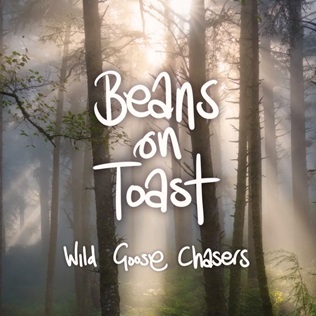 Artist:Beans On Toast
 Album: Wild Goose Chasers
Label: BoT Music
Tracks: 12
Website: https://www.beansontoastmusic.com/
His 17th studio album, released as ever on Dec 1, this is a somewhat different sound for Jay McAllister in that all the tracks feature just voice and piano (the music composed by Matt Millership) and, as such, tend to be more ruminative. The songs, however, remain very much in the BoT tradition of protest, politics and personal, with sharp observations and deep emotions.
A brief classical styled piano instrumental, the aptly titled 'Away With Words', opens proceedings before flowing into 'Faith In The Moon', a quietly anthemic supplication to seeking direction and embracing life ("Show me the path to follow that leads me to the truth/Show me the reason for our existence …Show me passion/Show me soul /Show me that you want it all/Show me that I've got everything and nothing lose"), that comes with the response "Don't forget to stare out to the stars/Don't worry about the big things while the little things fall apart/Don't forget about the feeling of the ground between your toes and don't forget the things that deep down inside you've always known/Because it will be over soon/Don't lose faith in the moon".
Taking an uptempo turn with the piano in saloon bar mode, 'The Midas Touch' follows a similar train of thought in "Cast your own bet/Make your own luck/and everything is relative to the hand you're dealt" and the caution that "Cast your own shadow/Cast your own spell/ Dig your own tunnel/And you poison your own well". Basically, be happy with what you have because everything is never enough.
Rolling piano notes carry the tide for 'Variety', a song about resetting things ("Reclaim the forest/Rewild the mind/Reward the stomach/Re-common the land/Rethink society And the system") and a reminder that, as Ralf Fiennes puts it in Conclave, certainty is the enemy of being open to ideas ("You don't have to keep your opinions to yourself/But you don't have to impose them on everybody else/I understand that we won't always see eye to eye/But variety is the spice of life"). There more social comment to be found on the slightly country toned 'Boring Dystopia' about getting away from what society has become ("I've had just about enough of you/With your token slogans/And simple things done wrong …Cutting every corner/Leaking bullshit"), He even delivers a sort of rap mid-way ("Sometimes we go low, sometimes we go high, but wherever we going we're going there fast, so be sure to keep your hands in the cart, keep your eye on the prize, and your head in the game, shoulder the concept, someone's to blame").
His inner Dylan burrows to the surface for the slow and stately 'Oh, What A Life' which, set to a melody Stephen Foster might have penned, offers up more wisdom about making your way in this feral world and trying to always have the upper hand ("the minute that you crown yourself/The power vanishes/And you just have to sit there and wear it/And it's hard to be humble/When you're playing the clown/Thinks the Jester as he steps into the spotlight/He'll perform for the King/But he's got the jump on him/ Because he knows what he's been doing in the moonlight"), the lyric managing to reference Crystal Palace burning, Hern The Hunter, Christopher Marlowe and, in a tribute to his Westgate, the last of the seven medieval gates that defended Canterbury and "tames the river Stour" as he and his daughter embark on a pilgrimage "To learn about our ancestors" when "these streets were paved with pilgrims/Writers and urchins", suggesting that the formal architecture of the city library somehow represents the loss of an ancient magic.
Another number with cascading piano notes, 'Myths & Legends' echoes a running theme and the need to rediscover that sense of the miraculous and faith ("we've lost all our shamens/All our totems/We lost any sense of hope… There must be a reason/We're put on this earth/Hidden in the meaning of life itself/Maybe we knew it/Somehow we forgot it/Lost it in religions/And modern economics") and the trust that a new generation will be the future myths and legends as they return to place their faith in Nature ("We can hear it in the wind/We'll find our purpose again...So we listen to the wind/Searching for purpose again/And will find it in the forests/Not in the technology"). He may just well be our answer to William Blake.
A jauntier ragtime show tune bounce, 'Why' is a playful ditty about the mysteries of life ("Why does the mushroom make you stare into the sky?...Why does the blackbird sing?... Who built the pyramids?...Where is Atlantis?...Who made the fruits the flowers and the fauna?/Who planted the first seed?... Who brought the Big Bang?/What made us conscious?... Who put the beauty in every little thing that gives us the urge to sing?") and a prayer for the strength and courage to find the answers.
Things get jazzy with the boogie woogie 'The Glorious Fool', a pilgrim's progress and, with allusions to homelessness and "the kindness of strangers" the message that, as heard elsewhere on the album, "Everything is different/Nothing stays the same/The one thing that you know for sure/Is everything will change/And it might change for the better/It might change for the worse/But change it must", and the need to live each day and be content with the food on your plate.
Last year he released his Little Bee children's album and picture book and 'The Bee's Nest In My Pebble Dash' continues in similar vein as he sings "I've got a home full of birds/Squirrels, bees and slugs/And little caterpillars/Dangling from above" and of having an "egg shaped stone/And ancient ritual/As symbol of fertility/And rebirth". However, while its image of the best nesting as a symbol of nature's resilience in the face of doomsayers and how "We don't need to save the bees/We need to respect them…we believe/They're dancing for the pollen/But that's a lie/They dance because they're happy to be alive") is a good one for little ears, perhaps calling them "Those clever motherfuckers" might not sit well in the primary classroom.
It ends as it began with an instrumental, 'Fairy Tale Ending', but not before the track from whence the title comes, 'Before The Flood', the classical piano sounding like a less bombastic Ferrante and Teicher, which speaks of the consequences of climate change denial ("It was sometime before the flood/After the fire/The moment that we realised/The science wasn't lying/Nobody did anything/Till it was an emergency/And the institutions/Started crumbling". But while it sounds pessimistic with "In the end, they didn't care about us/And the government abandoned us", his faith in common humanity rises like the dawn sun after the apocalypse to forge a braver new world ("the only thing that we could do/Was fend for ourselves/And we were all surprised/At how good that felt/Little communities/Broke from the poison tree/Started concentrating/On the problems that we could actually see/Things got ugly/And things went wrong/But people they managed to carry on/And in the end, we didn't care about the weather/We just carved out a path in between the disasters"). And yes, while history tell that "every Utopia/Ends in a scam", he charges "Don't underestimate the will to survive/Don't underestimate the need to stay alive/And take your place/In the human race" as he raises a toast to all those dreamers in the wild goose chase.
Very much his coming of age album where those earlier quick wordplay witticisms or acerbic lines have given way to a considered wisdom of the ages and a humanity worn in his heart rather than on than his sleeve, take wing with him.
Mike Davies
| Previous | Next |
|---|---|
| Helen Gentile & Lewis Wood: Violet Sky | Three Idle Women: All Hands Together |
Recent Reviews
- sundayclub:sundayclub
- The Lost Notes:Live At Symphony Hall
- Jon Loomes:Dust In The Sun
- Emma Jane:Lost At Last
- Celine Cairo:Panacea
- The Glass Hours:Chapel Glass
- Sailing Stones:Slow Magic
- Paul Mckenna Band:Uncovered - Live In Germany 2012
- Martin Carthy:Along The Road Forever: Live At The BBC 1965-2022
- Grasta:Golden Light
Variety
Fatea Showcase Sessions
The Fatea Showcase Sessions are a series of downloads featuring acts that we've really enjoyed and think that more people should get the chance to hear.
Corsair is the current session and features 16 fantastic artists check out the website to find out more about them and download your copy
www.fatea-showcase-sessions.co.uk for all the artist information.