Saturday
Saturday is one of my favourite days of the festival as well as being one of the longest. The alarm goes off at seven fifteen, after backing up pictures until one, for an hour and a half of writing and catching up stuff from the day before, before getting the right side of a full English and heading to the site to catchthe first workshop of the day, bodhran.
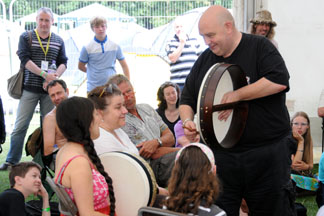 There have been some great Cambridge workshops over the years, but both Sam's yesterday and Gino Lupari's today seemed to take them into another league. Gino had set up off the stage and as is the want with the workshops was faced with as many different bodhrans as abilities, small deep tubs to larger shallower ones.
Initially he focused on care of the instruments, which have come a long way in the last few years, with some that are now tuneable, a whole different range of skins and sound, how they can be impacted by the weather and how best to get rid of the top end ring on a new bodhran, strips of painters masking tape, slowly applied until the sound gets sharper.
Gino is naturally a people person, laughing and joking with the attendees, putting them at their ease so as to make it easier to invite questions on and sharing anecdotes of mistakes that he made, both when learning the instrument and since.
Even without a bodhran brought along there were tricks of the trade that could be used with the instrument, particularly when being played as part of a session. The thing I found really interesting was his reminding people that essentially it's a support instrument and that whilst the solos can lead to blistering examples of the art, you have to be trusted by the rest of the musicians to keep them in time.
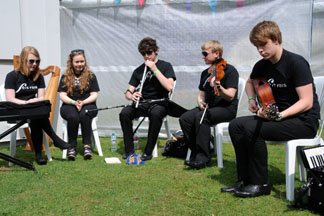
Scottish acts are more prominent at Cambridge than a lot of English based festivals and part of that is due to the collaboration between Cambridge and Creative Scotland, their equivalent of the arts council, which means acts that we may not otherwise get to see can make it south of the border.
Creative Scotland help support Feis Rois, which takes traditional music to youngsters and then supports them touring around Scottish regions, reconnecting them with their music. A group of Feis Rois musicians have been coming to Cambridge now for a number of years, with some of the lucky ones also able to get out to places like Australia and Canada. This year's Feis Rois musicians not only played on Stage 2 and the Club Tent during the festival, but I was also lucky enough top catch them at a Scotland At Cambridge reception to help cement the ties.
Time for one of my real festival treats The Brian McNeill Session, two and a half hours of back to back acts with something new every couple of songs. You get to see music combinations here that you will never see together anywhere else, including random bars around the Celtic Fringe.
Backstage before the Session really is organised chaos personified. Musicians of all types and creed, tuning up getting their stuff together, making sure they've all got their ideas sorted for the massed band opening and then suddenly there's a couple of minutes to go, it all comes together and everyone and I mean everyone files on to stage, The Brian McNeill Session is go and another year is notched onto a well scored belt.
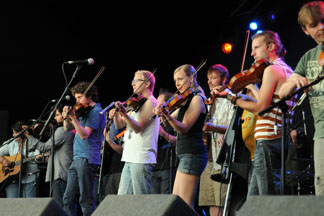
There is something really exciting about the opening mass ranked thrash. It really does build the atmosphere for two and a half hours of something special.
The mass ranks move away to leave Finnish act Frigg, who played Stage 1 yesterday.
A septet with a rank of four fiddle players supported, by bass, mandolin and guitar they kicked off with a set of songs whose title roughly translates as Lets Party and party they did, kicking off with a huge amount of energy. That's followed-by "Polka V" that just happens to be the title of the band's well received most recent album.
For two short sets of tunes they've kept things light and bouncy, one that definitely reflects the mood of the tent, ending with a hand clappy rock and roll influenced number that sees an outbreak of dancing on and off the stage. Quite a start.
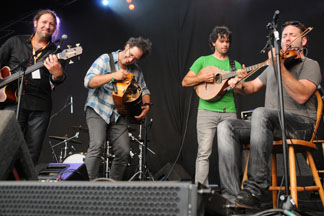
Next up comes Le Vent Du Nord and a bit of a contrast with their French Canadian sound, lead by a device that looks and sound like an electric hurdy-gurdy.
Whilst the band is setting up, Brian McNeill leads the audience in a refrain of "Blood Red Roses". The band now ready it's time to get back to the instrument lead material. There's a little bit of balancing the sound and it's time to kick off, literally as the percussion is stomp and clog. The bass player doubles up on Jews harp which adds an almost trance element to the song.
Having had a slow start they make up as they dive into the second song which combines tight harmonies with some seriously good call and response stuff. They play a song about the Quebec revolution in the eighteen hundreds, which they jokingly admit they lost.