

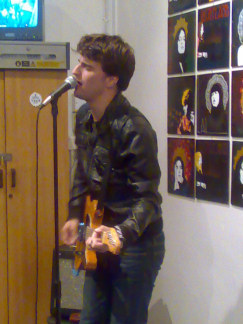
 Talking To...Jim Moray
#J That's sort of like the idea a pool of musicians. Lots of people all over the place that can upload to a shared space and exchange ideas. It's not necessarily having everyone playing at the same time or going on stage together, but still able to contribute.
#N Even whenever six or so of the band are in the same place they can do a gig under the name of the project.
#J And it sort of needs someone in the middle to curate and make things happen to make the connections. Again still only an idea, but you could also bring in writers and designers inspire, its all very prototype at the moment.
#N Are you touring again this year?
#J I'm not touring as such, I'm going to be doing a number of one off gigs. I toured fairly heavily early in the year, but I'm going to be playing gigs where I can go back home.
I'm also going to be doing a lot of producing between now and the end of the year.
#N There seems to be more musicians that are adding production to their bow at the moment, yourself, Stu Hanna, Sean Lakeman or is it that people are noticing production more?
#J Possibly, I'm not sure. I think it's that the spotlight moves and someone does a good job on one person's album, so someone else asks them to do theirs. I like the production side. You don't get involved in the same way you do when it's your ideas. It's interesting to hear other people's ideas and work on them. I find I can leave as a producer and think about something else, but when I'm working on my album's it's more of a consuming process. It's good to go to a party at someone elses house.
It's been really fun doing the Wistman's Wood album, because we've done that in a very specific way. It's a very live album, recorded around one microphone. There's very little mixing to be done.
#N Almost English folk recorded in a nineteen twenties bluegrass style, mixing the musicians at the microphone rather than the music on the tape.
#J That's sort of the idea, using a very very accurate stereo microphone. I get them to play with the headphones on until everything is in the right position and then when it's all where it should be, they take the headphones off and concentrate on playing together. Production should come down to working with the people, not the microphones and the leads.
I'm recording the Wheeler Street album shortly. That's due to start in October. I'm going to go up to Kent to do that. The idea to try and work that around being in one room and sort of feeling each other and being in the space. Try and get things cooking in the room and then record the room.
I've just realised that I've spent most of my time talking about my plans with other people and going forward.
#N If that's where you're at and that's what's exciting you, I think that's what I want to hear.
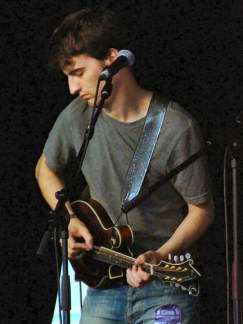
#J Time in music is a funny thing. The public and the artist have a different timescale. For me "Low Culture" is the last two years, most people have only been able to hear it since July. It's still very new to most people, but for me a lot of it was a year ago.
It's a mixed blessing, you're never quite in the same place as the people you're talking to.
#N And we keep on trying to haul you back to where you were.
#J Exactly and it gets even more strange when people want to talk about the earlier records as well. I was different at twenty one to what I am at twenty seven.
#N At twenty one you were described as being the biggest leap forward in folk for thirty years, do you think you've fulfilled that?
#J Six years down the line it's amazing how many people that tag has been applied to. [laughs] Back then it was original, but it's been applied to other musicians, I've seen it with Rachel Unthank, Imagined Village, all kinds of people since, you can't really take anything from it. Take it with a pinch of salt, like the next big thing. I think I stumbled onto something and it took me a while to figure out why it worked.
I've come to the realisation of what it is I do now. It's taken three records, but I know what I do well. I've matured as a musician and I think I understand it all. It may be that the focus we have on youth and young musicians in folk might be counter productive at times.
The good thing about folk music is that it's about a shared experience. I want to be like Chris Wood, I want to be making the best records I'm going to make in fifteen or thirty years time. It takes time for life experiences etc. to ferment and I want to keep making records that are better and better.
Unfortunately that doesn't seem to be the way the mainstream industry works, but you can still do that in the folk world. There always seems to pressure to move onto the next thing and there's not enough time spent nurturing
There seems to be a lot of focus on an artist because they are young, when the focus should be on better albums. I never really wanted to be in that position I just wanted to make good albums. You can do good work whilst working towards something better.
Albums are almost a step on the journey. In context I'm proud of my albums, but I wouldn't want people to think about me as one album. You can do something that strikes a chord and it can brand you for ever. It's not necessarily a bad thing if people accept that you as a person has to move on.
I think sometimes you can see that two/three strikes and you're out mentality starting to creep into folk music. Particularly if one album has left a mark and maybe if your first album didn't hit the mark or the second, there's a tendency for there not to be the third, no matter how good it might have been because you've now got experience.
I've been lucky and I'm grateful because people seem to allow me to keep moving on. They allow me to do something different rather than an album I've done before. It's not over by a long way, I hope to get older and wiser in my music.
On that positive note, thank you very much.