
Loading
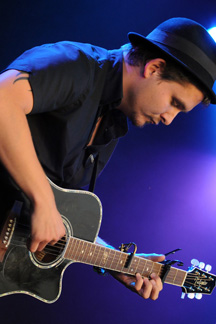
#NK Which leads neatly into a guitar observation, you always seem happy to reinterpret the work of your guitar heroes when you play live.
#ST Definitely. My big hero is John Martyn, he's the reason that I got into guitar playing. Then I really started listening to blues guitar players. There's a guitarist I'm really listening to at the moment, Snake Johnson. I've just got a CD of his, "They Call Me The Snake" and that's about all the information there is on it, but he's a great blues player, really raw, it sounds really fresh, almost like it was recorded yesterday.
I'm constantly listening to other guitar players, constant learning is part of life's journey. I like hearing how other guitarists put their songs together.
#NK You also don't limit yourself to songs about emotion, there's a lot of your songs about people,places and politics.
#ST I think as I've started doing longer and longer gigs, you have to think about the audience, the performance more. You've got to give people a real variety of songs. I love it when I play for about an hour forty, two forty five minute sets or even an hour. I can really start to show all the different sides of myself and play all different sorts of songs.
If I look back to my favourite gigs, they've all had that, Neil Young at Glastonbury, the range of songs, the range of melody. He'd do a big rocky one with the band, then he did "Heart Of Gold" on his own with the acoustic, it was such a range of performance. It wasn't just a great journey musically, it was a great performance. Even if you didn't like Neil Young, you had to say that was something pretty special.
#NK On performance, I've seen you play as few as one song as part of a festival session, three songs, right up to two forty five odd minute sets. Do you prepare for those in different ways?
#ST It varies. There have been times I've planned a set list, looked at the audience and just scrapped it. You can prepare, but I've rarely done a gig in the order I've written it. You have to feel how the audience react to what you're doing. You play the songs you want to play, but you also want to involve people. You have to adapt .to the room and make people part of it.
When I played the Den at Cambridge this year, I knew I wanted to play one quiet song, but then everything felt right to play another one, so I think I played "Ragland Road", which people weren't expecting, but it felt right, I knew folk audiences like that. I want people to be brought in, I like to involve my audience.
#NK And you can go from a gentle number, to deep down dirty blues.
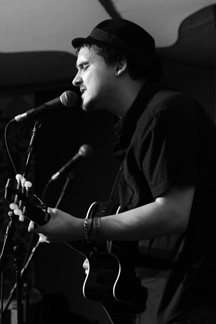
#ST Definitely. As I said, my hero is John Martyn and he was a master of that. He could be doing something using an echoplex and next "May You Never", it's just one guy and his guitar, the range and variety.
You can't get stuck in one genre, once you've done it, it's important to find new things.
#NK It's a great example of that one man and his guitar thing, how you can hold a really big crowd when it's just you and your instrument up there. Like Richard Thompson, him, his beret and a guitar.
#ST I don't think I'm ready for a beret yet, happy with my hat. It's quite rare to be able to do that, just you and your guitar, it does give you real flexibility.
I would like to have a band at some point. I think some of the new songs I'm writing for my next new album do lend themselves to having a band around me. They were written with different instruments in mind. I'm starting to build songs more and that seems naturally to move towards having a band.
#NK I'll come back to the band, but whilst we're still talking about performing, where did you develop your double capo technique? I can't recall seeing another performer using it.
#ST I have seen someone doing it years ago, I've even seen three capo on a guitar, which I remember thinking was mad. It came out of mucking about with the guitar and being very free with it. I was playing around with a tuning DADGAD, which I'd heard from Davy Graham, the Scottish guitarist. He came up with it to harmonise with a lot of African musicians when he was playing in Morocco.
When I learnt that tuning, it really opened up a lot of ways of playing and a lot of ways of writing songs, there is such variety there and I've never got bored of that tuning. You can do so much with it, including using two capo on it. You can do it on regular tuning, but on DADGAD it works really well.
What it means is that the bottom chord strings, the ones nearest your hand, are tuned to wherever you have the first capo and the second one is five frets further up the neck that give you a second tuning. It's not something you use a lot.
I was doing a course for kids and was asked about it. I'm sure there is a technical term for it, but I found it by experimenting and it felt right. The only way I could describe was about being free and trying things. If they work use it. If they don 't, don't. I look for other ways to play to stay fresh.
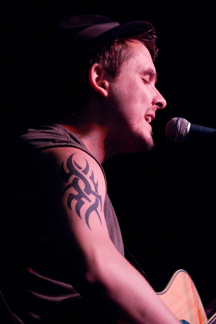
#NK When I stand next to guitarists at gigs, who know more about the instrument than I do, you almost see a look of WTF when then see the second capo go on and then, normally about half way through the song, you get a look of realisation that tells you they've sussed it. It's quite interesting watching other guitarists watching you during the songs you use it on.
#ST It's all about the sound and getting to be what you want it to be. Visually it looks quite good and does make people wonder what you are doing, but I use it on recordings, because it gives me a sound I want. When you are in different tunings it really gives you a chance to do different textures. With the capos, you can play off either one or even between them and the sound changes with it. It's definitely not something you would use on every song.
It helps with the variety, when you're just one person and a guitar or even one person and piano, you've got to do something that gives you something different to keep the audience entertained.
#NK Is that one of the reasons why you use the gob iron on some tracks or is it one of those things that's compulsory for a blues artist that you add blues harp alongside the guitar?
#ST Pretty much, I use it on two or three songs. [laughs] I don't know if it's compulsory for a blues artist, but it's a great thing to have on some songs. I've always liked harmonica players, I think Paul Butterfield is great, you know when you're hearing a good harp player, you know what it's adding to a song.
photo credit:
Neil King
Corrugations
Angels
Calcutta Grove
Walk With Me
The Fatea Showcase Sessions are a series of downloads featuring acts that we've really enjoyed and think that more people should get the chance to hear.
Click Here to get the latest session

