
Loading
 Frank Zappa
Moving on from the first tranche of reissues that I reviewed back in the autumn, we now come to the next batch of titles, reissued on the back of that first tranche in more or less chronological sequence. That means a trip through the diversity years, where prolific creativity on a number of parallel fronts necessarily brought a comparable increase in the number of album releases from Zappa and his Mothers, and an ongoing healthy expansion of his catalogue. It takes us from 1972's Waka/Jawaka (also known as Hot Rats 2) through some often intriguing byways and a number of live albums and on to 1979's iconic rock opera Joe's Garage. (Curiously, tho', the ostensibly complete series of Zappa catalogue reissues seems thus far to have skipped over the 1971 movie soundtrack 200 Motels, for reasons I've been yet unable to ascertain.)
As far as remastering goes, virtually all of this second tranche of discs comes with fresh 2012 mastering from the analogue originals, in most cases accruing considerable audio benefit. Waka/Jawaka is a strong case in point, where the 1995 CD reissue was somewhat muddied with reverb and the new CD incarnation has better bass response, gives finer definition to parts, and (as was the case with Hot Rats) there's loads of inner detail that I'm being made aware of here almost for the first time. The ensemble, which heavily features George Duke and Aynsley Dunbar on a roll, delivers jazz-rock fusion par excellence, and Waka/Jawaka was likely recorded at the same sessions as its followup companion The Grand Wazoo (another surprisingly overlooked 70s Zappa album), which almost audibly seems to carry on where the earlier album left off but with an even bigger-band complement. The Grand Wazoo gains similarly from the remastering process, in fact, sounding great and full of presence. The jazz idiom is persuasively explored, and The Grand Wazoo contains some radical scoring and structurings alongside some distinctly orthodox (but intensely satisfying) cool-jazz (Blessed Relief for instance). As all-instrumental offerings go, this pair of albums represents both a culmination of earlier achievements in that sphere and a creative peak for Zappa after the unfortunate nadir of Just Another Band From LA.
The pattern of vacillating affections amongst Zappa aficionados was set to continue throughout the ensuing decades, with polarisation of most releases into vocal and instrumental camps, and with high points almost always to be found more within the latter category. Nevertheless, the reappraisal process engendered by the reissue programme is a very useful one indeed, and the excellent audio status of the best of the remasters enables us to place greater value on both content and context. Some of the 70s albums come off especially well, and the almost-exclusively-vocal Over-nite Sensation is a good example; its vocal gestures are, happily, not exaggerated in the manner of some of the later albums, and generally free of obtrusive gimmicks; the album also contains plenty of seriously stunning guitar work from FZ himself (and even some uncredited guest appearances from Tina Turner no less!).
Apostrophe, released barely six months later, was a more discursive programme of songs and stories that some folks regard as one of Zappa's most typical and yet most accessible records; certainly it presents a sensible and feasible entry-point into the Zappa universe, is very well recorded and demonstrates all the musical skills FZ was continually refining. It also contains brilliant musicianship from Frank's hand-picked sidemen (and a guitar-bass jam with Jack Bruce on the title track), and intelligent arrangements that are satisfyingly complex and yet suitably tight to match the lean conciseness of expression in Frank's compositions. And it's another very successful remaster.
The live album Roxy And Elsewhere followed swiftly on the heels of Apostrophe, and captures the loose Zappa/Mothers band of 1973/74 in splendid form, and mostly at The Roxy, Hollywood, with a small amount of studio overdubbing. Like previous CD reissues of this set, it brings the 68-minute double album onto a single disc, but I'm surprised that the latest reissue still credits the 1992 digital master as its source (although the insert implies the existence of a 2011 transfer). Not that the sound is in any way inferior, but I'd have expected some expansion from original tapes to address the rather irritating fadeouts on tracks like More Trouble Every Day. The set does include some unnecessary rambling, and the audience participation section of Be-Bop Tango still gets tedious on repetition, while the sharp satirical bite of Frank's social commentaries is beginning by this time to feel a touch blunted on occasion by the emergence of ever more dubious turns of lyric and subject matter.
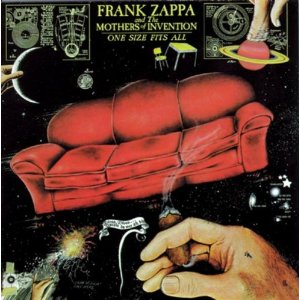
One Size Fits All, recorded mostly live during the production of a TV special and concurrent with the following studio LP (Zoot Allures), is regarded by many fans as a highpoint in the Mothers canon, with a crack band, great songs, superbly absurd surreal turns of lyric, fabulous playing and impeccable teamwork. Quite incidentally, it also pointed the way towards Zappa's next studio offering, Bongo Fury, which took the form of an official collaboration with Captain Beefheart (whose masterwork Trout Mask Replica Frank had produced several years earlier, the good Captain repaying the debt by singing on Hot Rats' Willie The Pimp and providing some uncredited cameos on One Size Fits All… In its 2012 mastering, One Size exhibits all the excitement and internal dynamism you could wish for, and without a doubt it stands as one of the best of the 70s offerings from the Zappa stable. And so to the second of 1975's Zappa releases, Bongo Fury. This documents some storming live performances from May of that year, where Frank and the Captain, who had been friends since childhood, traded sparks off each other onstage despite constant personal arguments and disagreements (the glowering, gloomy separation of the two men on the cover photo says it all). Musically, it's absolutely excellent, with some fantastic FZ guitar work (notably Muffin Man) and tight band musicianship that somehow manages to cope with the awkward, psychotic twists and turns of time signature. And the appeal of the whole disc isn't even compromised by the slightly limper tracks on which Beefheart doesn't appear. Sound and mastering-wise, no complaints here either.
Forward a whole year to Zoot Allures, a frustratingly uneven collection that's often regarded as "accessible Zappa", at times almost verging on easy-listening rock compared to the more bizarre and experimental sides of Zappa's creativity. I wouldn't quite agree with that assessment, although some of it definitely veers too far in the direction of self-parody (Ms Pinky, Wonderful Wino), and even the satire is a touch bland and predictable (Disco Boy and the cusp-of-punk quickie Wind Up Workin' In A Gas Station). But it's just about redeemed by its best moments: the mysterious title tune and Black Napkins (both featuring some top-notch guitar soloing), and the wickedly discomforting The Torture Never Stops. The sound quality is just fine, but there's not much interesting going on in the detail and the plain instrumentation.
It was over a year before Zoot Allures was succeeded, and that was by 1978's Zappa In New York live double (culled from 1976 performances). This was kindof a stall-setting summation set, with something for every branch of the Zappa-following fraternity - from inspired reworkings of earlier instrumental pieces (Cruising For Burgers, Sofa) to puerile panto sketches (Titties And Beer), intriguing minimalist experiments (Black Page) and manic escapades (Manx Needs Woman) to archetypal "lithoeroticisation" (Punky's Whips). The set also includes a revisit of Torture… Although the band are clearly having fun as well as showing off their musical cred, it feels as though some sections of the show may overstay their welcome a touch. But the quality of playing and singing, and the variety of cameo contributions, is hard to beat, while the 1993 digital master used as the source for the latest transfer is a model of clarity, suitably upfront and focused to do the job perfectly for this edition.
Studio Tan, released in the autumn of 1978, was another uneven studio collection, with the speeded-up-vocal gimmick device being over-used on The Adventures Of Greggery Peccary and proving ever-harder to stomach on repeated listening (despite the story itself containing some rather good individual lines and despite some admirably inventive compositional touches along the way). This 20-minute twinky embarrassment contrasts with the pair of sublime and thrilling instrumental pieces (Revised Music and RDNZL) that conclude the album. The next release, the studio-based Sleep Dirt, could almost not have been more different in character, although interestingly its source recordings date from between 1974 and 1976. It's a rather classy all-instrumental collection, with plenty of excellent guitar and Ruth Underwood's signature skirling marimba melodies, underpinned by some at times distinctively jazzy keyboard adventures. Quite uniquely within FZ's output, there's even a curious little acoustic guitar duet (with James Youman) on the title number, and some genuinely fulfilling soloing from Patrick O'Hearn and Terrio Bozzio (on The Ocean Is The Ultimate Solution), while the lounge-like Flambay is a kind of sequel to Hot Rats' Little Umbrellas; indeed, the whole album could be regarded as a stylistic follow-on from Hot Rats and Waka/Jawaka, a kind of alternate part 3 to The Grand Wazoo in that trilogy. The brand new remaster from the original analogue source tapes is brilliant, detailed and full of body and presence, and should be your instant choice, since it's how the album was intended to sound (note that the master used for the 1990s Rykodisc CD reissue incorporated some extraneous additional vocal parts, which thankfully have been expurgated for the 2012 release).
Following closely on the release of Sleep Dirt came one of Zappa's best sellers in terms of chart success, the double-album Sheik Yerbouti, the bulk of whose basic tracks were recorded live during the 1978 tour at the Hammersmith Odeon. It's never been one of my favourite Zappa albums, but this excellent new remaster almost convinces me it has more substance after all, as its clarity, venue ambience and sense of spontaneity demonstrate. Even so, these qualities, and the all-round instrumental excellence, can't redeem for me the often quite embarrassing mish-mash of unashamed sexual smut (I Have Been In You), snide philosophical ramblings (Broken Hearts Are For Assholes) and "deliberate shock value" character sketches that don't really come off (Dancing Fool, Bobby Brown Goes Down, Jewish Princess), and although the humorous intent/content does contain flashes of brilliance (Adrian Belew's Dylan impersonation on Flakes, for instance), even these flashes don't always bear repeated listening when the novelty wears off all too quickly. The cryptic little interpolations, and the occasional instrumental like Rat Tomago, come as something of a relief amidst the discofied rock grooves of much of the rest of the material, well drilled and expertly arranged though it is. A matter of personal taste methinks… tho' I still can't deny that Sheik Yerbouti is still an impressive set, especially now that this new remaster undoes the tampering of the earlier CD issues by restoring the cuts Frank himself had made on them.
1979's next release, Orchestral Favorites, provides probably the most apt instance for the inclusion of Frank's favourite quote (Edgard Varèse's "The present-day composer refuses to die"), for it serves up fulsomely-scaled (if at times a little tentative) orchestral arrangements of what might be termed favourite Zappa compositions - e.g. Duke Of Prunes, Bogus Pomp, the charming, tasteful waltz Strictly Genteel - often with a distinctly experimental bent that, with typical Zappa genius and flair, simultaneously invokes and juxtaposes atonal classicism, cartoon and film music, pointillism and modern jazz. Pedro's Dowry and Naval Aviation In Art are closest to the abrasive sound-world of Varèse and its idiosyncratic percussion gestures. And there's even room for some trademark Zappa guitar (on Duke Of Prunes). It's all very satisfying for the adventurous listener, in tying together the strands of Zappa's instrumental experimentalism, influences and predilections, even though fans will disagree on the merits of these versions of the tunes as against the original outings on previous albums (or indeed the versions on the later, 80s LSO records). And the 2011 transfer used for this reissue brings out all the complexities of detail almost effortlessly.
Frank's final release of the decade was the three-act "rock opera" (in all but name) Joe's Garage, an ambitious narrative cleverly chronicling through different musical styles and idioms the career and adventures of a "regular" guy living in a kind of dystopian society. Ample opportunity, of course, for Frank to display his talent for satire, social comment and musical parody, also to pay homage to the kinds of music he grew up with and holds in affection, and to indulge in his penchant for unorthodox musical (and sexual) practices. The linking device of a narrator (The Central Scrutinizer) seems to derive directly from the disembodied whispery studio voice first heard on Are You Hung Up? (WOIFTM). Joe's Garage also makes copious use of the xenochrony technique, whereby guitar solos (and sometimes other passages) from earlier live recordings are routinely (albeit creatively) overdubbed onto fresh studio recordings. Only the epic, cinematic mood piece Watermelon In Easter Hay departs from the xenochrony to any significant extent, and contains one of Frank's best (and ironically, pretty well controlled) guitar solos on record, and a surprisingly moving experience emotionally (which is saying something…). Joe's Garage is a pinnacle of the Zappa œuvre, and its achievement can be widely celebrated through this handsome new 2012 remaster, an essential acquisition.
David Kidman
Pete Seeger:Pete Remembers Woody
Matthews Southern Comfort:Kind Of New/Kind Of Live
Ian Matthews:If You Saw Thro' My Eyes/Tigers Will Survive
Gary Quinn:This Cowboy's Heart
Richard Townend:Take The Sunshine
Southern Brotherhood:Magic Carpet Ride
The Fatea Showcase Sessions are a series of downloads featuring acts that we've really enjoyed and think that more people should get the chance to hear.
Click Here to get the latest session

