
Loading
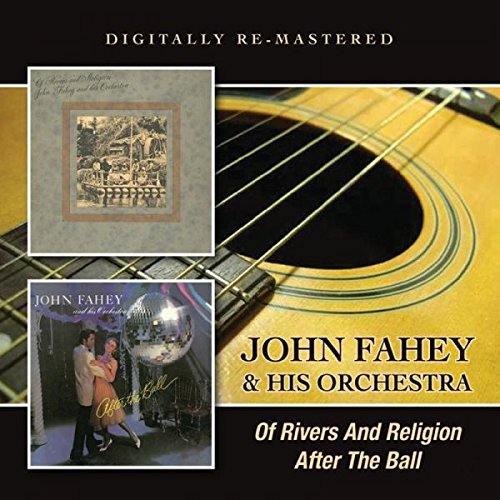 John Fahey & His Orchestra
 John Fahey, self-styled “American Primitive” guitar maverick and veteran of seemingly innumerable releases on his own independent label Takoma during the heady late-’60s, made a trio of albums in the early 1970s under the billing/guise of John Fahey & His Orchestra – a bit of a misnomer, for the extra musicians backing his extraordinary guitar work only appeared in any significant proportion on a very few cuts, and there was little of the sense of large ensemble that the word “orchestra” would necessarily imply. However, the results are both satisfyingly rootsy and listenable, certainly in comparison with many experimental and adventuresome passages on Fahey’s earlier solo albums. And yet neither album was anything like a commercial success, eventually leading Fahey to sink into alcohol-fuelled depression by the mid-70s.
The first two of the so-called “Orchestra” albums are gathered together conveniently on one disc here. They originally appeared on the Reprise label in 1972 and 1973 respectively, and while Fahey’s signature guitar was still placed at the forefront (he played purely solo on Song and Funeral Song For Mississippi John Hurt, both his own compositions, for example), other key flavours were introduced via the ancillary instrumentation, giving a number of tracks a distinct New Orleans Dixieland jazz feel (check out Texas And Pacific Blues, for instance) while others (Dixie Pig Bar-B-Q Blues) encompassed a kind of mando-jugband vibe. Each album employed a slightly different complement of session musicians, although some – multi-instrumentalist Chris Darrow (ex-Kaleidoscope), trumpet player and arranger Jack Feierman (who’d played with Count Basie), clarinettist Joe Darensbourg and bassist Joel Druckman – were common to both albums. Much of the material was traditional in origin, although Of Rivers And Religion also included a pleasing rendition of show tune Ol’ Man River.
Followup album After The Ball was ostensibly more wayward than its predecessor in both construction and overall feel, though not seriously so. And even so, it contained within its generally more light-hearted grooves some way-better-than-decent music-making, ranging from the quintessential Fahey soloing on a handful of tracks (including the bustling opening Horses and the pretty, if mournful portrait Beverly), moving on to the uke-laden Hawaiian Two-Step, a heavily-scored version of Rev Gary Davis’ Candy Man, a delicious chugalong Temperance Seven-style take on the obscure Dixieland number New Orleans Shuffle, a woozy lope through I Wish I Knew How It Would Feel To Be Free and the affectionately-scored show-tune title track (which is done slightly tongue-in-cheek perhaps, and devoid of guitar). But I like it all !
These two albums represent what booklet-note writer John O’Regan describes as “a radically underappreciated yet fiery and fertile period for the guitarist”, in effect occupying a position of leftfield “curios amongst a career of curiosities” in the wondrously kaleidoscopic tapestry that is indigenous creative Americana and providing “a link between Stephen Foster, Dixieland jazz and rural blues mixed with vaudeville balladry”. Quite… And they’re also hugely enjoyable, and haven’t dated a jot.
David Kidman
John Kirkpatrick:Tunes From The Trenches: Songs From The First And Second World Wars
Townes Van Zandt:The Late Great Townes Van Zandt
Steve Skaith:"Latin Quarter":Bare Bones
Dave Rawlings Machine:Nashville Obsolete
The Fatea Showcase Sessions are a series of downloads featuring acts that we've really enjoyed and think that more people should get the chance to hear.
Click Here to get the latest session

