
Loading
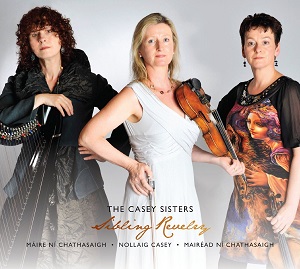 The Casey Sisters
 Now who had the brainwave to bring together these three musical sisters for an album of truly joyous music-making? … You’ll know the ladies individually, of course, as front-runners in their respective fields of musical endeavour: Nollaig Casey as fiddler and singer (she also plays viola and tin-whistle), Máire Ní Chathasaigh as harpist extraordinaire (also piano and keyboard player), and Máiread Ní Chathasaigh as singer and fiddler (who also plays tin-whistle and low flute). Unbelievably, the deliciously-titled Sibling Revelry is the sisters’ first recording together (mind you, they’ve all had busy and fruitful individual careers), and yet the teaming here reveals a further inspired level of musicianship that’s beyond the intuitive. They excel on their respective instruments, sure, but they also possess an innate grasp of internal dynamics (whereby felicities of balance are keenly observed) and an uncanny ability to listen to each other and respond in kind, rejoicing in spontaneity of expression.
The material chosen for this album is thoughtfully and impeccably arranged, and ideally sequenced for optimum listening pleasure. It comprises mainly instrumental items, with just three songs carefully interleaved; of these, two are sung by Mairéad and one by Nollaig, and both singers display both a constant purity of tone and an unassumingly accomplished clarity of diction. The instrumental repertoire is an enterprising selection of traditional tunes, largely from manuscript collections, with one by O’Carolan and one by Máire herself, while the ten-minute closing track, the six-part Bandonbridge Suite, has individual sections composed by individual sisters. Good use is made of the possibilities of both arrangement and studio facilities for imaginative presentation; sometimes, Nollaig doubles her fiddle parts or else creates a mini-string-section by adding the darker timbre of viola to the mix, while the colours of tin-whistle and low flute add further variety to five of the selections and Máire’s harpistry is as skilled and scintillating as ever. Arty McGlynn’s guitar accompanies deftly on three tracks, including the final movement of the Suite, and Chris Newman plays bass on one of the songs. Even so, one of the album’s standout tracks is Nollaig’s pindrop solo performance on her adaptation of Lament For General Monroe.
The entire album represents a glorious and wholly delectable celebration of expertise in sibling musicianship of the highest order, and proves a life-affirming experience, a joy from start to finish.
David Kidman
John Stevens' Away:John Stevens’ Away/Somewhere In Between/Mazin Ennit
Gong:The Radio Gnome Invisible Trilogy
Gillian Glover:Still Life With Music
Rodney Crowell:Ain't Living Long Like This/But What Will The Neighbors Think?/Rodney Crowell
Eilen Jewell:Sundown Over Ghost Town
Natalie MacMaster & Donnell Leahy:One
The Fatea Showcase Sessions are a series of downloads featuring acts that we've really enjoyed and think that more people should get the chance to hear.
Click Here to get the latest session

