
Loading
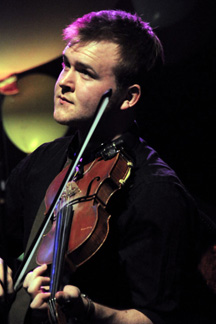
What do you get if you take an extraordinary story, presented by three of the very best English folk musicians and one of the most prominent figures in the Oral Storytelling Tradition? Answer- a truly wonderful show. And that is exactly what "Sam Sweeney's Fiddle-Made In The Great War" is, a truly wonderful show.
Sam Sweeney has teamed up with fellow Bellowhead member Paul Sartin, Full English bandmate Rob Harbron and storyteller/writer par excellence Hugh Lupton to create a stunning multi-media production which tells the story of Richard S Howard, a violinist and luthier from Leeds and the fiddle that he partially completed before being called up to fight in the Great War in 1916. Richard was killed at the Battle of Messines in Belgium in 1917 and the unfinished instrument was given to his daughter Rose Howard as a memento of her father. Rose kept the parts of the unassembled fiddle all her life and when she died they passed to luthier Roger Claridge who finished making the instrument, over ninety years after Richard Howard began it. Sam bought the completed fiddle from Roger and looked into its history, with help from his Dad, Chris Sweeney.
The story of Richard Howard and the unfinished fiddle provide the inspiration for this wonderful show, with the music composed by Sam and Rob and the words written by Hugh.
The stage set is a combination of a luthier's workshop, with numerous unfinished instruments scattered about, and a military scene. A spotlight picks out Richard's now-completed fiddle, the story of which is told in the second half of the show.
The first half sets the scene, with an inspired choice of music and storytelling, which demonstrates the crossover between military music and music from the folk tradition , as exemplified by a delightful duet from Sam and Rob of John Clare's "The Battle Of Prague", followed by the familiar "March Of The British Grenadiers".
This was followed by Paul Sartin's superb rendition of John J. Blockley's "The Scarlet And The Blue", an 1870's recruiting song in which a ploughboy, who is tired of country life, enlists in the army ["no more will I go harvesting or gathering the golden corn"].
Next up was Hugh Lupton's epic narration of "The Death Of Hector", from the Trojan Wars, a reminder that British Army officers would entertain fellow soldiers in the trenches with tales from Greek and Roman mythology, which they had learned at public school. Paul Sartin then sang a wonderful song from the Test Valley "Home Lads, Home", in which soldiers will "all go home together at the setting of the sun".
The first half ended with Sam and Rob's "Rose Howard", named after Richard's daughter, which acted as an overture for the main event.
The story begins in a luthier's workshop as Hugh tells how the unassembled parts of the fiddle were "remembered". This word has a double meaning, in that the fiddle is physically re-assembled, whilst at the same time not forgotten. The fiddle is one of "exceptional sweetness". Sam finds a label inside the body of the fiddle bearing the legend "Richard S Howard, Leeds, 1915" and "Made in the Great War". It is as if the fiddle is demanding that its story be told.
We are taken to the Leeds Palace of Varieties where Richard works as a musician and we are treated to a selection of Music Hall numbers, ranging from "The Irish Paganini "[Sam, of course] to "Take Me Back To Dear Old Blighty" and "What Did You Do In The Great War, Daddy?".
Following this light-hearted and thoroughly entertaining interlude, the atmosphere changes dramatically as Richard returns home to be told of his conscription into the army. He goes to his workshop and lays out the parts of the unfinished fiddle, saying "You'll have to wait".
After a lovely instrumental piece, "The Wellesley II", which is the regimental march of Richard's unit, we find ourselves at the Front in Flanders on Zero Day, 7th June 1917, for the battle of Messines. The British explode mines under the enemy lines with huge loss of life to the German army [estimated at 10, 000 dead]. The terrible violence of the battle is graphically described by Hugh and is portrayed by booming drums, flashing lights and a ghostly harmonium.
Whilst Richard survives the battle unscathed, he is later killed by a German gunner who, somehow, escaped the onslaught. This sets the scene for one of the most poignant moments of the show, when Sam sings "The Ballad Of Richard Howard", the lyrics of which are based on the traditional folk ballad, "The Cruel Sister", in which a fiddle is made from the parts of a corpse. Hugh has cleverly re-written the lyrics to describe the death of Richard Howard. It was an incredibly moving moment which had some members of the audience in tears.
After Richard's death, the unassembled fiddle is given to Rose who promises "to keep it always, as long as I live".
The show ends with film of Sam playing Richard's violin by his grave at Messines and it is another spine-tinglingly emotional moment in this wonderful production.
If you have not been lucky enough to see the show, do not despair as Sam has released an album containing the music and storytelling. Do try to give it a listen because, like Richard Howard's fiddle, it is story that demands to be heard.
Peter Cowley
There are only so many hours in a day and only so many gigs we can get to. We'd really like to expand our national coverage of the live scene as it remains the life blood of music.
Are you able to help us and the artist you're seeing out by dropping us a review once you get back home, and maybe even a picture. If you are able to help, Mail Us your review and we'll get it up as quick as we can
The Fatea Showcase Sessions are a series of downloads featuring acts that we've really enjoyed and think that more people should get the chance to hear.
Click Here to get the latest session

