
Loading
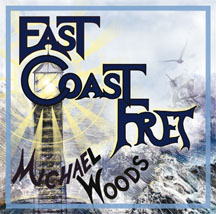 Michael Woods
 Confession time … in the past I've tended not to "go a bundle" on all-instrumental CDs, not only because they can be notoriously difficult to review (especially when one is not a practising musician!) but also because they can so easily be one-dimensional and merely a triumph of technique over content. However, in recent years I've encountered some honourable exceptions to that rule, and Michael Woods' latest record is one more such.
Durham-raised, now based in Tyneside, Michael's a fingerstyle guitarist par excellence with more than three decades of performing experience that includes appearances at many major blues and folk festivals. East Coast Fret is his third CD, and his second purely instrumental release; its canny title plays on the three principal meanings of "fret" - the raised bars or ridges on the guitar fingerboard; the fog coming off the North Sea; and the expression of worry or bother (which may give rise to the blues) - all of which have their part to play in the disc's musical content.
Michael's prime inspiration - and musical "home territory" - is the Piedmont (east coast US) blues (key practitioners: Blind Boy Fuller, Blind Blake and Blind Willie McTell): a style characterised by the highly syncopated rhythms and stride-piano-like gestures that inhabit the ragtime end of the blues spectrum. Three of the disc's 14 tracks are Rags by title, but over half of the remainder betray a definite ragtime inspiration, whatever their tempo marking and level of purely melodic invention. However, all of the tracks are Michael's own compositions and display an easy, ready authenticity (a gift he shares with the legendary Eddie Walker). The cakewalk-style Tin School Rag is arguably the most brilliant of these, with some particularly scintillating fast manoeuvres that refuse to trip Michael's fingers over themselves (while on Baltic Rag I did get the feeling that he had to take one particularly tricky transition at a slight rallentando each time round for that very reason!). Blue House Rag contains some surprising twists and turns, whereas the jubilant Celebration March turns out to be more of a quickstep.
While on another level, there's also the need to bear in mind Michael's statement that "many of the album's tunes are inspired by north-eastern landmarks or events". That's not to expect pictorial programmatic tone-pictures or impressionistic doodling, but instead an intelligently lyrical kind of depiction within the notes and chords and the relationships between them; you don't necessarily need to have the pictures by your side while you're listening, but in some cases the proverbial movie does start playing in your mind. Rather in the manner of the works of Michael Chapman, I thought (the opening track Blink Of An Eye, a veritable five-minute epic, has the air of a classic Chapman sequence that builds into a breathtaking finale), or John Fahey (the rustic bottleneck slide piece Broken Wing Mirrors). Some tunes (Split Crow Road, the title track and the jaunty yet pensive singing stroll of Bagatelle) evoke the rambling troubadour lyricism of Ralph Mc Tell, while an air of what I can only describe as folky antiquity pervades Haddricks Mill and the stately fragment Lady Jane.
All told then, this is an immensely enjoyable record. I find it impossible to get bored with Michael's playing, or with the (inevitable) aural and tonal limitations of the guitar, through which humble medium Michael's gentle passion for his art and soul, his commitment to unobtrusive virtuosity, is able to elevate his music to something rather special.
David Kidman
Sarah Jarosz:Build Me Up From Bones
The Black Feathers:Strangers We Meet
Chris Ridgeway:Three Small Things
Gavin Marwick:The Long Road And Far Horizons
Suzanne Vega:Tales From the Realm of the Queen on Pentacles
Lincoln Durham:Exodus Of The Deemed Unrighteous
Crafting For Foes:Borrowed Ground EP
The Fatea Showcase Sessions are a series of downloads featuring acts that we've really enjoyed and think that more people should get the chance to hear.
Click Here to get the latest session

