
Loading
 Get The Blessing
 Jazz is essentially an improvised music. As such it can be challenging to the listener, especially one brought up on the simpler tunes of folk or the repetitive rhythms of rock or dance music. But at times, musicians gainfully employed in commercial music become bored with simple tunes and repetitive riffs and beats. That is what happened to Jim Barr, bassist with Portishead, and his bandmate (and also second 'live' drummer with Radiohead) Clive Deamer. A desire to create music more flexibly, and a shared love of the free-improvisation 'harmelodics' of Ornette Coleman, led them to form Get the Blessing with jazzers Jake McMurchie (saxes) and Pete Judge (trumpet). The result is modern music with groove, space and subtle complexity, and it is a fascinating example of the way in which improvised music is emerging to which younger audiences can relate, (think also Snarky Puppy, Gogo Penguin and Troyka).
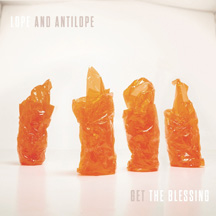
Lope and Antilope is the fourth album from Bristol-based Get the Blessing, the follow-up to 2012's OCDC (named after Ornette Coleman - OC - and his cornet player Don Cherry - DC). Unlike previous albums, however, the pieces on the new cd were not composed prior to recording, but developed over a 4-day stint in Jim Barr's studio in Bristol. The result is a series of grooves and minimal themes, which develop in interesting and (yes!!!) loping fashion. The bass and drum rhythms propel the music forward to provide the horns, in particular, with creative space for their improvisations. This is well illustrated by tracks such as the opener Quiet where Deamer's brushwork and Barr's simple, repeated bass riff allow space for McMurchie's sax (bent through electronics to sound as if it's being played with a whammy-bar!) and Judge's plaintive trumpet to explore the theme. The sound, built on a repetitive groove is rather reminiscent of John Zorn at his more contemplative. Little Ease adopts a similar approach, but has a heavier sound with the sax (baritone?) glowering almost like a second bass, allowing Judge's trumpet to float, then scream over the top; again the mix of acoustic and electronic sound helps to maintain interest.
Corniche starts with a riff that sounds like Kraftwork (Trans-Europe Express?) allowing horn themes to evolve over sparce drumming and a 5-note bass riff. Judge plays a flugelhorn solo which carries shades of Harry Beckett (certainly no bad thing!). Antilope starts with a horn riff, leaving McMurchie to jump off on a gently rolling tenor theme - no Ornette here: the sound could be the other Coleman, Hawkins! This leads into a funky bass solo and muted trumpet ending. Luposcope starts with eerie industrial sounds - like a ship approaching Bristol docks through the fog - with the trumpet buried deep behind a simple guitar plucked sound (is that Adrian Utley - occasional additional musician with GTB?). Viking Death Moped adopts a similar atmospheric, over a fast, insistent bassline (Kraftwork's Autobahn this time?). This is more jagged, and lacking in 'lope'. It must already be in the running for best track title of 2014!!
Hope (For The Moment) is another rolling groove, with some similarities to Jimmy Giuffre's 'The Train and the River', which again allows the horns to play around with some short minimalist themes. Trope is a slower 'lope' with reflective, almost melancholy trumpet and sax riffs fading in and out of the soundscape. A chillout piece with circular, Zorn-like themes. It is followed by Lope which does exactly what it says on the tin! Again, the simple bass riff underpins unison horn themes, trumpet snatches, and lots of electronically-processed sax and trumpet solos until it builds into something approaching a melody, for McMurchie to play his tenor solo over. The final track, Numbers, lopes into something approaching a conventional tune before a guitar solo comes in against a background of processed trumpet, leading back into a faster section theme, which collapses into a fuzz bass riff and snare drum beat into the final fade.
This is an album to listen to and revisit, full of creative interplay, sonic tricks, clever minimal solos and huge and varied atmosphere. It takes jazz forward, whilst delivering an accessible music which is relevant to the second decade of the new Century. Get The Blessing have some tour dates in the spring, so don't miss the opportunity to catch them live, if they come your way.
Treat your Ears and order/download a copy - make this your New Year's Resolution!
Martin Price
Ashley Hutchings:By Gloucester Docks I Sat Down and Wept
Shona Tucker & Eye Candy:A Tell All
The Velvet Underground:White Light/White Heat (45th Anniversary Deluxe Edition)
Aly Bain & Phil Cunningham:The Best Of Aly & Phil, Volume 2
Leyla McCalla:Vari-Coloured Songs
Aly Bain, Ale Möller & Bruce Molsky:Meeting Point: Live At The Liverpool Philharmonic
Henry Priestman:The Last Mad Surge Of Youth
Tom Mank & Sera Smolen:Swimming In The Dark
The Fatea Showcase Sessions are a series of downloads featuring acts that we've really enjoyed and think that more people should get the chance to hear.
Click Here to get the latest session

