
Loading
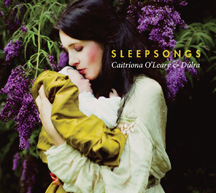 Caitríona O'Leary & Dúlra
 Caitríona is a charismatic and well-regarded sean-nós singer, and yet she's probably better known (at least on the recording front) for her parallel career in early-music ensembles Sequentia, eX, Joglaresa and The Harp Consort. In the sean-nós field, however, she's been busily exploring the three basic strands of traditional song in Irish mythology, via a CD-trilogy which has been gradually appearing in instalments over the past dozen or so years. Goltraí (laments) appeared in 2001, Geantraí (songs of joy and happiness) in 2012, and now, finally, the set is completed with Suantraí (ancient Irish lullabies and songs on the theme of sleep). The folk music scene has released a number of albums of lullabies and suchlike of late (notably that by Jackie Oates), but the compass of Suantraí is both narrower and wider than this apparent competition, certainly entirely different in repertoire terms, and the disc enjoys a unique and haunting ambience that both fulfils the promise and consolidates the approach of the earlier volumes of Caitríona's trilogy.
I need to point out first that the folk enthusiast who is used to hearing sean-nós source singers, and especially from field recordings, may initially be unseated by the singular purity, evenness of tone and cultured, trained quality of Caitríona's voice. Its intensity and passion are qualities of true beauty, but this means it inevitably lacks the rough edges and momentary imperfections of the untrained sean-nós singer. Personal preference will thus dictate to what extent one appreciates, and can cope with, Caitríona's delivery. Laying that necessary qualification aside, then, I can now concentrate on celebrating the extremely high standard of this disc - which conforms to, and I'd say probably surpasses, that set by its two predecessors. It's clear that the very nature of Caitríona's delivery, specifically its chant-like purity - is much informed by her early-music work (and to some extent world music and contemporary classical), and this extends to her choice - and style - of accompanying instrumentation. Indeed, she founded the ensemble Dúlra herself, in order to bring audiences a new way to experience traditional Irish music. Dúlra consists of just four musicians (fiddle, flute/whistle, cello and bodhrán), who are augmented (or in some cases part-substituted) by other players (clarinets, bass viol/lirone and percussion) on some tracks. Even though Dúlra has within its ranks some of Ireland's key traditional musicians, their music here takes on less the spirit of the session and more of that of conscious arrangement - and yet is none the worse for it, for the impact of the band blend is strong within its own pre-ordained context.
The carefully-researched repertoire that Caitríona presents on this disc is termed "a posie of old and new sleep songs", and it ranges from gentle, everyday lullabies to soothe a restless baby (Seobá Mo Leanbh, Cuirfidh Mé Féin Mo Leanbh A Chodladh and Seoithín Mo Leanbh), a little dandling-song (Cosa Buidhe Árda) and a simple, lovely children's song (Little Cuckoo) through to gem-like story-songs which may recount the responses of their protagonists to intervention from supernatural forces like fairies (A Bhean Úd Thíos… and Ar Mhullach An tSidhe) or even convey a doomed love affair through restless animal imagery (Codail Beagán). Many of these selections are rarely-heard and enterprisingly arranged, with these latest performing versions often having been compiled by Caitríona from various sources, but the degree of unity attained is persuasive. On only four of the selections does Caitríona perform a cappella (I'd have liked to hear more). And yet, perhaps the closest Caitríona comes to what might be termed a "traditionally decorated" sean-nós vocal delivery is on Codail Beagán and the song Rachaidh Sé, and that aspect is emphasised on the tracks which employ ancillary drones in the arrangement. Elsewhere, An Seóthó employs a backbeat that resembles passages in Britten's Church Parables. On the final track, the aforementioned A Bhean Ud Thíos…, Caitríona even sings slivers of the verse in a gamelan scale, utilising a gamelan accompaniment (in place of the Dúlra grouping) which ingeniously invokes both the faery magic within the lullaby itself and a kind of unearthly "alternative reality". It's a pity that no fewer than four of the selections turn out to be purely instrumental renditions - beautifully performed and arranged though they may be, these prove no substitute for sung versions (I'm thinking particularly of Tá Mé 'mo Chodladh), especially in the light of Caitríona being the named focal point of the collection.
For Caitríona's musical personality really does impart a special atmosphere to the disc: thrillingly intimate, intense and mesmeric - but never soporific (many of the tracks may be lullabies, but they won't send you to sleep!). And the disc's additional aura of high-class product is ideally complemented by its most lavish, elaborate and handsome packaging. The humble CD is encased within a sturdy digibook, which contains photographic images created to resemble Pre-Raphaelite paintings and staged to evoke the disc's song lyrics; these are reproduced in their entirety (and with translations), together with Caitríona's own detailed explanation of the sources of text and tune and her rationale for arrangement. So this release is quite literally a work of art, not just a beautifully sung, played and engineered audio CD.
David Kidman
Julie Fowlis:Gach Sgeul (Every Story)
Martyn Bennet:Grit (Expanded Edition)
Ten Years After:Live At Reading '83
West My Friend:When The Ink Dries
Run Out The Guns:Powder & Shot
The Fatea Showcase Sessions are a series of downloads featuring acts that we've really enjoyed and think that more people should get the chance to hear.
Click Here to get the latest session

