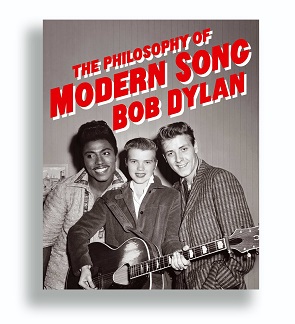
The Philosophy Of Modern Song
Bob Dylan - Simon & Schuster
In 2004 Bob Dylan wrote a memoir, the first part of his autobiography if you like, Chronicles, Volume 1, but being Bob Dylan, he wrote about different times in his life - living in Greenwich Village in the early 1960s and making the albums New Morning (1970) and Oh Mercy (1989). Fair enough as we assumed that there would be other volumes covering different periods, and then we could put them together how we wanted. However, we forgot that we were talking about Bob Dylan and here we are 18 years later and there isn't even a Volume 2. Part of me says I should have realised this as Dylan works to his own agenda.
Simon & Schuster must have been pressing Bob for a second volume but what they've been given instead is an incredibly interesting book, The Philosophy Of Modern Song, which is nowhere near as pretentious as its title, presumably another Dylan joke.
During lockdown, Bob Dylan listed some favourite records and wrote about them. The 66 essays vary in length and are usually accompanied by contemporary photographs and pictures of the artists. The presentation is first-rate and this book is so enjoyable that I am hoping that there will be The Philosophy Of Modern Song, Volume 2, but I don't hold my breath.
As you might expect, there is nothing straightforward about these entries and sometimes it is hard to know how Dylan really feels about things. Whilst praising Elvis Costello, he acknowledges that Costello is not for everyone as "he exhausted people. Too much in his songs for anybody to actually land on. Too many thoughts, way too wordy. Too many ideas that just bang up against themselves."
Recognise anyone in that? Certainly, that can be true of Elvis Costello but I always presumed he was taking his lead from Bob Dylan. Here, the man who wrote 'A Hard Rain's A-Gonna Fall' is accusing Elvis Costello of being too wordy. It's preposterous but is it because Dylan is having fun with us? He knows that Elvis got a lot from him, even acknowledging a heavy dose of 'Subterranean Homesick Blues' in 'Pump It Up'. Is Dylan really pretending to be a critic of his own songs? You can overthink these things, but Dylan as per usual is being his own mysterious self.
As far as songwriters go, the highest praise is bestowed on Townes Van Zandt as Dylan loves the way he hones his songs to the bone. Dylan attributes this to the after-effects of Townes' treatment for manic depression. How does Dylan know this? Does it come from talking to Townes or is it speculation? It's a fascinating thought and one that I'd not heard before.
And Dylan can be extremely funny. He imagines Pete Townshend in a few years' time: "You're an 80-year-old man being wheeled around in a home for the elderly, and the nurses are getting on your nerves. You say, 'Why don't you all fade away?' You're in your second childhood, can't get a word out without stumbling and dribbling. You're talking about your generation." But then he is sympathetic by saying John Prine's 'Hello In There' is a song about how we treat the elderly. 'Dirty Life And Times' by Warren Zevon is "a deathbed confession, a song that corrupts itself and corrupts others."
Talking of the elderly, he is bemused by the audiences for the Rolling Stones: "It's like being at a porno convention". How does he view the audiences at his own concerts?
Dylan comments on how times change. When Eddie Cochran recorded 'Nervous Breakdown', he had no way of knowing that when heard through modern ears, it would be deemed politically incorrect. He talks about the use of drugs in popular music but this is prompted by listening to Sonny Burgess' 'Feel So Good' from the 50s.
When Dylan compares the Platters' 'The Great Pretender' with Jackson Browne's 'The Pretender', he says, "Like many things even pretenders got devalued between the 50s and the 70s." I think he's being playful and funny: he wants to get you thinking rather than offering definitive conclusions.
Dylan is inconsistent. He praises Dion for his many rebirths - rock'n'roll, folk, religious songs and now blues - but he calls Bobby Darin - rock'n'roll, country, folk and Vegas cabaret - a chameleon and says, "If you don't watch them changing colours, they look like ordinary lizards."
As you might expect, Dylan loves pre-war vintage country and he heaps praise on Johnny Cash and Willie Nelson. He calls Marty Robbins' 'El Paso' a "post-resurrection song" and he wishes Sam Phillips had produced 'CIA Man' by the Fugs. He says Ry Cooder "improved every record he ever played on."
There are little glimpses into Dylan's own life: "Being a writer in not something you choose to do. It's something you just do. And sometimes people stop and take notice." He agrees with the sentiment of Johnnie Taylor's 'Cheaper To Keep Her' as "divorce is so expensive".
If you want to know a song that makes Dylan cry, try 'Nelly Was A Lady', a 19th century Stephen Foster song recorded by Alvin Youngblood Hart in 2004. He praises Rick Nelson for his emotional detachment but is that really a compliment?
Dylan contrasts Mose Allison's 'Everybody Cryin' Mercy' with the Temptations' 'Ball Of Confusion'. His section of Edwin Starr's 'War' includes comments about the effectiveness of protest songs and because of the USA's involvement in war atrocities, he says, "If we want to see a war criminal, all we have to do is look in the mirror."
My favourite comment comes when Dylan is discussing Jimmy Reed. He says, "You can't do too much with your harp in a neck rack." Isn't that fishing for compliments?
Read this book: it may annoy you but it certainly won't bore you.
Spencer Leigh
Fatea Showcase Sessions
The Fatea Showcase Sessions are a series of downloads featuring acts that we've really enjoyed and think that more people should get the chance to hear.
Corsair is the current session and features 16 fantastic artists check out the website to find out more about them and download your copy
www.fatea-showcase-sessions.co.uk for all the artist information.
