
Come Sing Again
Exploring Martin Carthy's 'new old' album
Martin Carthy's first entirely solo album in 21 years will be released this year on his 84th birthday. A key feature of Martin's recent live shows has been his purposeful revisiting of several songs from his earliest recorded repertoire. I had speculated for some time that this might signal a desire to revisit some of those old songs on a new album. The announcement of Transform Me Then Into A Fish confirmed this. It consists of 11 songs, eight of which originally appeared on Martin's eponymous debut album in 1965, with the remaining three having featured in his live and recorded repertoires to varying degrees in recent (and not-so-recent) years.
It's not unusual for Martin to revisit songs from his past. He's sung different versions of some of the songs from his debut album, and entirely rewritten and rethought others. Some have rarely left his live repertoire, while others have dipped in and out, occasionally vanishing as quickly as they seemed to have appeared. What follows is an attempt to catalogue the various versions, revisions and variations of the songs from his new album that he has been known to sing in the intervening decades.
Lovely Joan was a key song in the development of Martin's preferred guitar tuning in the late 1970s. Dissatisfaction with that classic 1960s folky tuning DADGAD led, through some experimentation, to the discovery of DADEAE, with which he had some success, if also an apparent degree of frustration. Further experiments led to CGCDGA, which pleased him specifically because it allowed him to sing Lovely Joan. He quickly recorded a version for his 1979 album Because It's There and it's rarely been absent from his live sets since. It's a song of resourcefulness and fidelity with a tune that so impressed Ralph Vaughan Williams that he nicked it for his own Fantasia on Greensleeves. All of Martin's versions, including the one on the new album, bear that same tune.
If Lovely Joan is the song from Martin's first album that has been in his recent live sets the longest, High Germany comes in a close second. He has a habit of suggesting he re-learned it during the COVID lockdown, which may well be true, but it gives the impression that he hadn't sung it for some time. It actually re-entered his repertoire at least 20 years ago and has been there fairly consistently since. There's a version on a 2006 DVD and a live recording from 2015. As his live repertoire over the last decade-or-so shifted towards a reappraisal of his earliest recorded material, High Germany was always there as a key indicator of that shift. The version he sang in 1965 was from a broadside source, and whilst his latest recording has essentially the same words and tune, his way of singing it has developed some interesting melodic variations along the way.
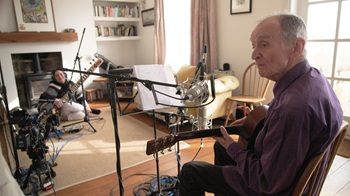
It's not entirely clear where the version of The Trees They Do Grow High that Martin sang on his first album was sourced. His sleeve notes reference versions from the 18th and 19th centuries but also note the "many English versions", of which his is most likely one. He was singing essentially the same version in 1978 when he was recorded in a Belfast folk club for what became the January Man live album. We can assume the version he sang for a John Peel session in April 1975 also tapped the same source, although it's unclear if a recording survives, so we're unable to check. What we do know is that the recording on Transform Me Then Into A Fish also revisits this same source, although Martin has been known to sing an entirely different version on more than one occasion.
A wax cylinder recording of a Mr Penfold made by Ralph Vaughan Williams in the village of Rusper in West Sussex was the source for the version of The Trees They Do Grow High that Martin sang with Brass Monkey on their Head Of Steam album in 2009. It differs in both tune and words from Martin's earlier recordings and from the recording on the new album, but it had also been the template for the version he sang with Wood Wilson Carthy in the late-1990s. This trio was only active briefly around this time and released their sole album in 1998. The Trees They Do Grow High wasn't on that album, but a live recording of Mr Penfold's version from late-1996 survives from a BBC source and will be on a forthcoming Live At The BBC box set.
There isn't much evidence of Martin singing Ye Mariners All between its inclusion on his 1965 debut and its resurrection on the first Waterson:Carthy album in 1994. There were a few very minor tweaks to the text in that later version, and there are more still on the new album, which does away with the repeated final verse entirely and is leaner and more direct for it. That said, all three recordings obviously originate from the same source, which in this case is the Dorset singer Marina Russell, having been noted by the Hammond Brothers in the early part of the last century. An earlier version was printed in the 1850s, although Martin suggested in his 1965 sleeve note that the tune may be older still. A key feature of the latest version is Eliza Carthy's fiddle accompaniment. It isn't Eliza's only appearance on the album, which she also co-produced, but it may be her most expressive and impactful.
Martin re-wrote the verses to A-Begging I Will Go when he sang it with Dave Swarbrick in the late-1980s. It was deliberately cast as a contemporary response to the persistent presence of beggars on the streets, and a version was released (as The Begging Song) on his Life & Limb album with Swarbrick in 1990. Ever the tinkerer, he continued to tweak the words and a later version, recorded at Swarbrick's 50th birthday concert, included a couple of additional verses. It's this longer, revised lyric he sings on the new album and it's one of his more powerful vocals. The brief period where his guitar drops out in the last verse, before returning for the concluding chorus, is as breathtaking as anything on the album.
Scarborough Fair is the most notorious track on Martin's 1965 debut and it's safe to say that Martin had no desire to revisit the song for many years. It must therefore have taken some major arm-twisting to get him to re-record it, which he did a couple of times for the BBC in the 1990s and 2010s. It re-entered his repertoire proper in a completely different version around 2014 when he was invited to sing it for the BBC drama Remember Me by the composer Ruth Barrett. He recorded a version on the Norma Waterson & Eliza Carthy album Anchor in 2018 and it remains a part of his live repertoire. He was recently heard talking about the song and singing an unaccompanied version on the In The Roud podcast. The recording on his new album is one of three tracks that feature sympathetic sitar accompaniment from Sheema Mukherjee.
The version of Scarborough Fair that Martin originally learned in the early 1960s was from a Peggy Seeger and Ewan MacColl collection, The Singing Island. The impact of A.L. (Bert) Lloyd on Martin's earliest work is well documented, but it would be remiss to disregard the influence of Seeger and MacColl on Martin directly, and more generally on the generation of folk singers to which he belonged. The Ballad of Springhill, which tells of a mining 'bump' (an underground collapse) that took place in Nova Scotia in 1958, is credited to Seeger and MacColl, although it is acknowledged to be largely Seeger's work.
Martin didn't have a lot to say about The Handsome Cabin Boy in his 1965 sleeve note. It's from a broadside and is one of several songs in the tradition where the female protagonist dresses as a man. In this instance, she does so in order to pass as a sailor for reasons which, beyond the mild suggestion of wanderlust, remain unspecified. There's an odd euphemism ("by eating of the captain's biscuits"), that's common to several versions of the song, the inevitable result of which ("the waist did swell of pretty Nell, the handsome cabin boy") is treated as little more than a joke by the other (male) sailors. Until now, neither this nor The Ballad of Springhill appear to have featured significantly in Martin's repertoire in the years since they appeared on his first album.
.jpg)
Martin credits Eliza for highlighting the notion that the ordinary English public considered Napoleon something of a hero, making the point that there are very few songs in the English tradition celebrating the Duke of Wellington, but a great many in praise of Napoleon. One such song is The Dream of Napoleon, which Martin has played live a lot in recent years. He recorded a version (as Napoleon's Dream) on the 2019 Topic Records anthology Vision and Revision, where he noted the influence of the traditional singer Sam Larner, who recorded his own version with that title in the late-1950s.
There was a time when Martin might have been an actor, but little evidence remains of his thespian abilities. There's his 'blink-and-you'll-miss-it' role as a lift operator in the early 1960s B-movie Return Of A Stranger, and a musical contribution, requiring even less dramatic expertise, to a 1969 BBC For Schools production, Chips With Everything. A slightly more substantial acting opportunity presented itself in BBC Pebble Mill's pioneering 1983 production of The Battle Of Waterloo. Broadcast live to air, the production saw Martin play the surly Wolfhound, one of a number of infantrymen who endured the battle itself and its grim aftermath. Martin sang excerpts from another Napoleonic ballad, The Eighteenth Of June, at the beginning and end of the programme and the starkness of his unaccompanied performance, whilst still in character and full battle dress, was a striking feature of the broadcast. 23 years later Martin performed The Eighteenth Of June for the BBC again, as part of a concert focussing on the tradition of socially committed song. Martin's version appears to have been the subject of some revision by the late Mike Waterson. The BBC recording is another that will appear on the Live At The BBC box set, and it may have been its inclusion there that prompted Martin to revisit it in his recent live sets.
Perhaps the most surprising inclusion on Transform Me Then Into A Fish is Martin's new take on The Famous Flower of Serving Men. He recorded this for his 1972 album Shearwater and again for his most recent truly 'solo' album, Waiting For Angels in 2004. It may be the most celebrated example of him reworking a song from the tradition. While the first five verses in the Child collection enthused him, he found the broadside text that followed frustratingly bland. He set out to reconstruct the song from a variety of sources, making up large chunks along the way when necessary. If you've heard Martin tell this story, you may have also heard him recite, rather than sing, those first five verses. On Transform Me Then Into A Fish he takes this approach one step further, delivering the entire 32 verses as a spoken-word piece. It's an astonishingly brave approach, the result of which is remarkable and moving. It's also somewhat fitting, given that the last several decades have seen Martin's singing voice develop a conversational quality that has edged ever closer in resonance to his speaking voice.
Of his voice on the new album, it's worth noting that it has never sounded more careworn, but neither has it been more honest. This is precisely how you might expect a gentleman in his 80s to sound. As much as anything, Martin is a storyteller. His timing, which was always his greatest strength, still has the power to stop you in your tracks on these recordings, even if the physical strength of his singing voice has suffered the inevitable consequences of the passage of time. That said, far from evidencing a decline in his vocal capability, this is a record of a man rediscovering his voice and refining his storytelling expertise.
Kevin Boyd (April - May 2025).
Editor: Come Sing It Plain… A Martin Carthy Fansite and #CarthyArchive: The Martin Carthy Broadcast Archive
Transform Me Then Into A Fish is released on 21 May 2025.
High Germany
Fatea Showcase Sessions
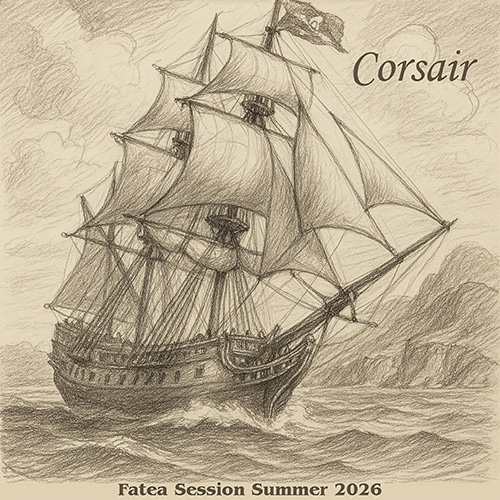
The Fatea Showcase Sessions are a series of downloads featuring acts that we've really enjoyed and think that more people should get the chance to hear.
Corsair is the current session and features 16 fantastic artists check out the website to find out more about them and download your copy
www.fatea-showcase-sessions.co.uk for all the artist information.