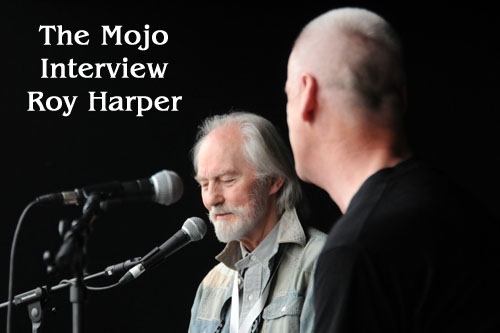
There is something intimidating about Roy Harper. I have on a couple of occasions made a derisory attempt to get 'into' him (normally after listening to Pink Floyd's 'Wish You Were Here') but was always put off by the volume of his back catalogue which runs to over twenty studio albums plus a similar number of live and compilation albums from a career that has lasted closer to fifty years than to forty. Buying a compilation would, obviously, have been the obvious thing to do but even that seemed a daunting prospect: should I go for the basic 'an Introduction to...' or the more expansive 'Counter Culture'? What I really needed was someone (or something) to point me in the right direction; something like The Mojo Interview.
In Cambridge terms the Mojo Interview is a relative newcomer (it is yet to get into double figures) and is an easy way to start the day (unless you are into workshops - I'm not). These are not Paxman style hard hitting interrogation just some gentle questions acting as signposts to guide the artists through their career.
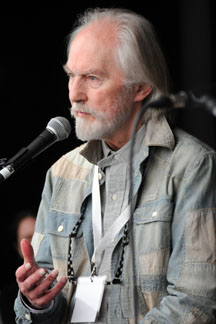 In Harper's case it started with his Cambridge Folk Festival memories. He "thinks he came to the very first one, because I was knocking about with Paul Simon at the time" but "might not have done", "definitely came to the second one" and "played the third one" where he wore a scarlet South American shirt. On whether he identified with being called 'folk' singer or not Harper described his musical influences starting from the 19th century romantic poets when he was 11 years old, through to skiffle two or three years later which was "like a sledgehammer that hit us" and how his dad "listened to the ice-skating on the radio" which gave him a love of classical music. When you add to that a jazz element it's easy to see why he has always had a problem with the folk singer label.
Harper first came to prominence in the mid sixties folk boom and, along with the likes of Long John Baldry (who damaged a his new guitar with his cufflinks), Paul Simon, Alex Harvey (who wanted to form a band with him), Pete Green and Nick Drake frequented a circuit of venues including Bunjies, Les Cousins, the rockier Marquee and proggy UFO and Middle Earth. It was a melting pot of ideas with a lot of cross pollination as they watched and listened to each other play.
In the seventies Harper was called the fifth member of both Led Zeppelin (who recorded 'Hats off to (Roy) Harper' on Led Zeppelin III) and Pink Floyd (Harper sang lead vocals for 'Have a Cigar' on Wish You Were Here) and whilst he agreed it raised his profile he denied that it was important as he was an "ethereal character" and a "non-combatant, a non-figure". He was though, grateful especially to Jimmy Page who he called "a gentleman" and Robert Plant who he thought would make a perfect king.
The Zeppelin memories led onto the trouble he got into with the song 'Watford Gap' or, more specifically, the line 'Watford Gap, A plate of grease and a load of crap'. Unsurprisingly the owners of the said motorway service station were not impressed with this blunt criticism of their cuisine and it led to Harper's label EMI insisting on the track being dropped from his album Bulinamingvase (the service stations owner was also a EMI board member). Harper fought against this censorship and, although unsuccessful in the short term, one of the first things he did in 1993 after obtaining the rights to his back catalogue was re-instate it.
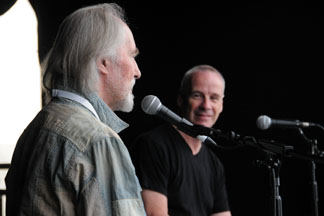 Being a cricket fan I was especially interested to hear his recollections of 'When an Old Cricketer Leaves the Crease'. I thought it was the only Harper track that I actually knew but later that evening when he played Stage 1 I recognised 'Highway Blues'. Harper was asked if it was just a song about cricket or if was a song about "wider truths, mortality and all the rest of it". It was, he replied, his "hymn for the passing of life in these islands … it's couched in a cricket metaphor but it speaks from somewhere else." And went on to explain that a lot of his songs were like that, and he would 'put a shell on them but is not what the core is actually perhaps all about a lot of the time". Amazingly it took Harper about thirty minutes to write and was inspired by the great John Arlott (a cricket writer and commentator and who was instrumental in bringing Basil D'Oliveira to England which had a direct impact in South Africa's exclusion from international sport until the abolition of apartheid) and he went onto explain how the melody was written in the key of C because it would give it the most gravitas and how the inclusion a jazz based chord wouldn't endear him the English Folk Dance and Song Society.
As well as a musician Harper is also an actor who appeared (as a rock star) in the 1971 film 'Made'. As the filming started the star of the film had not shown up and it became apparent that unless Harper "got into the sack with her first" she wasn't going to start filming. The film hung on this balance between "what she wanted to do and what I had to do". It ended up in a "really sad place" and you could tell that he is still somewhat scarred by the experience.
As the interview drew to a close Harper is asked about the future and current music. Poetry and long songs are still close to Harper's heart as he has a new song based on Keats' epic poem Endymion as he feels that he has reached the time in his life when he is able to do it.
Harper is one of those people that I'd like to spend a couple of hours of a Saturday afternoon with, preferably in pub. I doubt very much if I'd get to say very much, but then, why would I want to? As for starting my Roy Harper collection I'm still undecided between 'An Introduction to' and 'Counter Culture'. As one has 'Highway Blues' and one has 'An Old Cricketer..." I think I'll have to buy both.
John 'The Jacket' Hawes